Jordan’s Q2 2026 GDP Expands 3.0%, Outperforming Regional Headwinds, International Forecasts
ENV-KUWAIT-SUSTAINABLITYKuwait strengthens environmental sustainability through strategic initiativesBy Zahra Al-Kadhmi

HLT-KUWAIT-SURGERYKuwait advances health sector with robotic, remote surgeryBy Mohammad Al-Moseb

Saudi Arabia’s Voluntary Carbon Market Fuels the Shift to a Low-Carbon

Muscat
Maritime Resilience Forum Reviews Ways to Enhance Readiness of Maritime
Networks
Muscat,
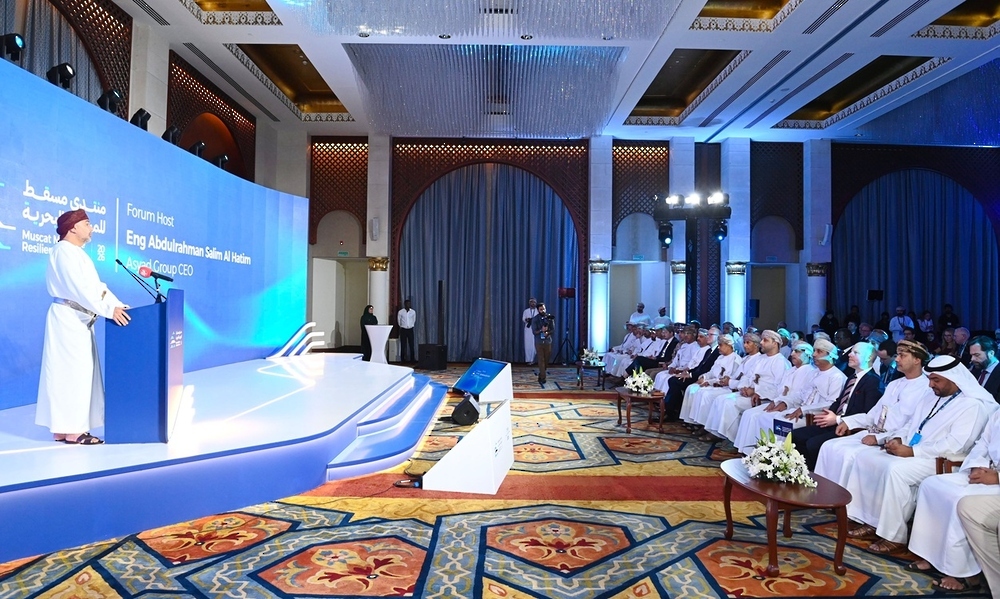
27 Oct 2026 (ONA) — The proceedings of the “Muscat Maritime Resilience
Forum 2026” began in Muscat today to review challenges facing the maritime
sector and practical experiences, as well as to explore opportunities to
enhance cooperation among various components of the maritime and logistics
system.
This
contributes to developing practical solutions to enhance the resilience and
readiness of maritime networks, while supporting the continuity of supply
chains and the flow of global trade amid rapid developments.
The
opening of the forum was held under the auspices of Eng. Said Hamoud Al
Maawali, Minister of Transport, Communications and Information Technology.
The
forum features the participation of a number of leaders and experts, organized
by Asyad Group in partnership with the Foreign Ministry, the Ministry of
Transport, Communications and Information Technology, and Oman Investment
Authority, within the framework of efforts aimed at consolidating the Sultanate
of Oman’s position as a hub for international dialogue on the future of global
trade and the resilience of maritime networks.
Eng.
Khamis Mohammed Al Shammakhi, Undersecretary of the Ministry of Transport,
Communications and Information Technology for Transport, explained that the
forum serves to enhance the Sultanate of Oman’s role in the fields of maritime
transport and maritime services, noting that the forum brings together a group
of decision-makers and stakeholders in maritime transport, confirming the
importance of the Sultanate of Oman’s role as a country overlooking major
maritime trade corridors and highlighting its attractiveness for such
conferences.
For
his part, Sheikh Humaid Ali Al Maani, Head of the Diplomatic Academy at the Foreign
Ministry, affirmed that the forum represents a qualitative shift for Omani
diplomacy to act as a catalyst for international trade, cooperation, and
building partnerships that yield benefits for the economy of the Sultanate of
Oman and the region.
Al
Maani noted that economic diplomacy serves as a catalyst for building private
partnerships, given the immense trust in Omani diplomacy, emphasizing the
necessity of leveraging current risk management to create opportunities for the
Sultanate of Oman and the region, and making Muscat a host for these maritime
gatherings, as the Sultanate of Oman is a key strategic partner in the region
for maritime trade and supply chains.
From
his side, Eng. Abdulrahman Salim Al Hatmi, CEO of Asyad Group, delivered a
speech clarifying that maritime networks play a pivotal role in the continuity
of global trade, as more than 80 percent of global merchandise trade by volume
is transported by sea. He added that the developments witnessed in maritime
trade and associated challenges affect transport movement and supply chains,
highlighting the importance of proactive readiness through sustainable
investment in infrastructure, enhancing operational readiness, strengthening
commercial partnerships, and exchanging field knowledge and expertise.
He
added that the results of an operational study conducted by Asyad Group
revealed a 137 percent change in the total cost of a maritime voyage between
India and Sohar, reflecting the scale of variables that may impact maritime
trade economics. This underscores the importance of embedding resilience
through continuous cooperation among companies, markets, and institutions, as
well as integrating efforts to address challenges and support the continuity of
trade movement.
He
explained that hosting the forum in Muscat allows bringing together leaders of
the maritime and logistics sector to exchange expertise and transform visions
into practical pathways, drawing upon Asyad Group’s integrated expertise in
ports, maritime transport, and logistics services, thereby contributing to
enhancing the efficiency and interconnectedness of maritime networks and
supporting international trade flows.
In
turn, Dr. Ibrahim Bakhit Al Nadhairi, CEO of Asyad Shipping, said that the
Muscat Maritime Resilience Forum positions the Sultanate of Oman on the global
decision-making map in maritime transport. He affirmed that the Sultanate of
Oman is a trusted nation in this field that consistently contributes to
bringing viewpoints closer together. He added that the participation of
numerous experts from inside and outside the Sultanate of Oman demonstrates the
interest of decision-makers in reaching a common mechanism ensuring the
flexible continuity of the maritime transport sector, which positively impacts
consumers.
The
forum included several working sessions to discuss challenges facing the
maritime sector, practical experiences regarding operational and commercial
visions, and the identification of practical priorities to enhance the
readiness and interconnectedness of maritime networks, as well as supporting
the continuity of supply chains and trade across markets.
The
discussions contribute to developing the Muscat Maritime Resilience Framework,
which Asyad Group seeks to establish as the first integrated global framework
based on the expertise of participating leaders and practitioners. This aims to
define practical priorities ensuring sector resilience, supply chain
continuity, and deeper commercial cooperation, with the dialogue’s outcomes
expected to contribute to formulating a common reference responsive to
operational and commercial developments in global maritime trade.
Hosting
the forum comes as an extension of the Sultanate of Oman’s approach to
deploying its economic diplomacy and international relations built on trust,
dialogue, and cooperation. This sovereign approach integrates with its
strategic location overlooking maritime trade routes, along with its ports,
infrastructure, and integrated logistics services connecting regional and
international markets, ensuring a supportive environment for maritime leaders
to meet and explore new pathways that enhance trade connectivity and maritime
resilience.
—Ends/AG