ENV-KUWAIT-SUSTAINABLITYKuwait strengthens environmental sustainability through strategic initiativesBy Zahra Al-Kadhmi

HLT-KUWAIT-SURGERYKuwait advances health sector with robotic, remote surgeryBy Mohammad Al-Moseb

Saudi Arabia’s Voluntary Carbon Market Fuels the Shift to a Low-Carbon

Under UAE President’s directives, UAE launches urgent relief response for Ghana flood victims

Street Theatre in Iran: When the
City Becomes a Stage
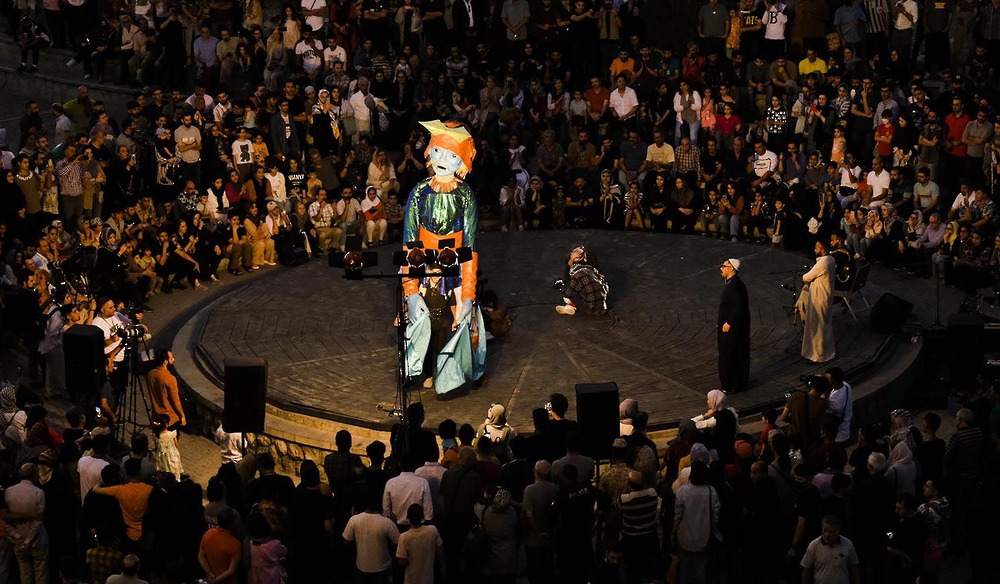
Tehran, 28 Sep 2026 (ONA) — Street
theatre in Iran is not merely the transfer of a theatrical performance from a
closed hall to an open space; it is an extension of a long history of popular,
narrative and ritual performance forms that, across different eras, have been
founded upon the direct relationship between performer and audience.
In recent years, Iran has witnessed
numerous theatrical experiments in public places, where streets, squares and
even spaces linked to working, social and cultural life have been employed to
reach audiences directly.
In this context, theatre researcher
Ali Hakimian told Oman News Agency (ONA) that understanding street theatre
requires viewing it as a meeting point between traditional theatre, urban
space, popular participation and contemporary social and cultural issues.
He added that Iranian theatre has a
long history of using non-traditional spaces, such as the art of “Naqqala,”
one of the oldest forms of dramatic performance, in which the naqqal carried
historical and mythical tales between the court, villages, coffeehouses,
caravanserais and other public places. Hence, it may be said that the idea of
taking performance out of the hall is not entirely foreign to Iranian
theatrical culture, even if the term street theatre in its modern sense is tied
to more recent developments.
Hakimian explained that street
theatre in Iran does not represent a single form, and several trends and styles
may be observed within it. Social theatre is among the most prominent trends,
as it addresses the themes of daily life such as family, the environment, work,
migration, social relations and the issues of children and youth. He noted that
the fundamental advantage is that the artist does not wait for the audience to
come to the theatre but takes the performance to where they are, and from this
standpoint street theatre can reach segments that may not frequent traditional
theatres for economic, social or cultural reasons.
The researcher explained that comic
theatre also holds a special place in Iranian street theatre, noting that
movement, rhythm, music, physical exaggeration and caricatured characters are
important tools in constructing the performance. This aspect is partly linked
to the ancient popular traditions of Iranian theatre, particularly the
traditions of popular comedy and improvisational performance.
He stressed that ritual and heritage
theatre is likewise an integral part of street theatre in Iran, as some artists
revive elements of Iranian heritage such as traditional costumes, folk tales,
local music, collective movement and traditional characters, whereby street
theatre becomes a means of re-presenting heritage to a contemporary audience.
He noted that environmental theatre
is one of the forms of street theatre, where the street is not merely a place
in which the play unfolds but becomes one of its elements: a building’s window
can be part of the scene, a public square part of the set, or the movement of
passers-by an unexpected element in the performance. This lends street theatre
a nature that cannot be entirely replicated in a closed hall.
He mentioned that children occupy a
prominent space within street performances, particularly in parks, cultural
occasions and public celebrations, and that the visual and kinetic nature of
street theatre helps attract children even when they have no prior interest in
theatre.
The researcher stated that this
theatre is characterised by linguistic and cultural diversity, as Persian can
appear alongside Kurdish, Turkish, Arabic and other local languages and
dialects. The use of dialect can bring the performance closer to the local
audience, particularly when it addresses a subject connected to the life of the
region.
Hakimian expressed his belief that
street theatre in Iran is in essence a story of the relationship between art,
place and people. Perhaps the distinctiveness of street theatre lies in the
fact that it does not ask the audience to enter the world of the theatre, but
rather seeks to find the theatre within the audience’s own world — in the
square, the park, the market, the street and among passers-by. Here the street
is transformed from a mere passage into a cultural space, and the passer-by
from a transient recipient into a potential spectator and perhaps a participant
in a theatrical moment that cannot be repeated in the same way again.
— Ends/Khalid