Jordan’s Q2 2026 GDP Expands 3.0%, Outperforming Regional Headwinds, International Forecasts
ENV-KUWAIT-SUSTAINABLITYKuwait strengthens environmental sustainability through strategic initiativesBy Zahra Al-Kadhmi

HLT-KUWAIT-SURGERYKuwait advances health sector with robotic, remote surgeryBy Mohammad Al-Moseb

Saudi Arabia’s Voluntary Carbon Market Fuels the Shift to a Low-Carbon

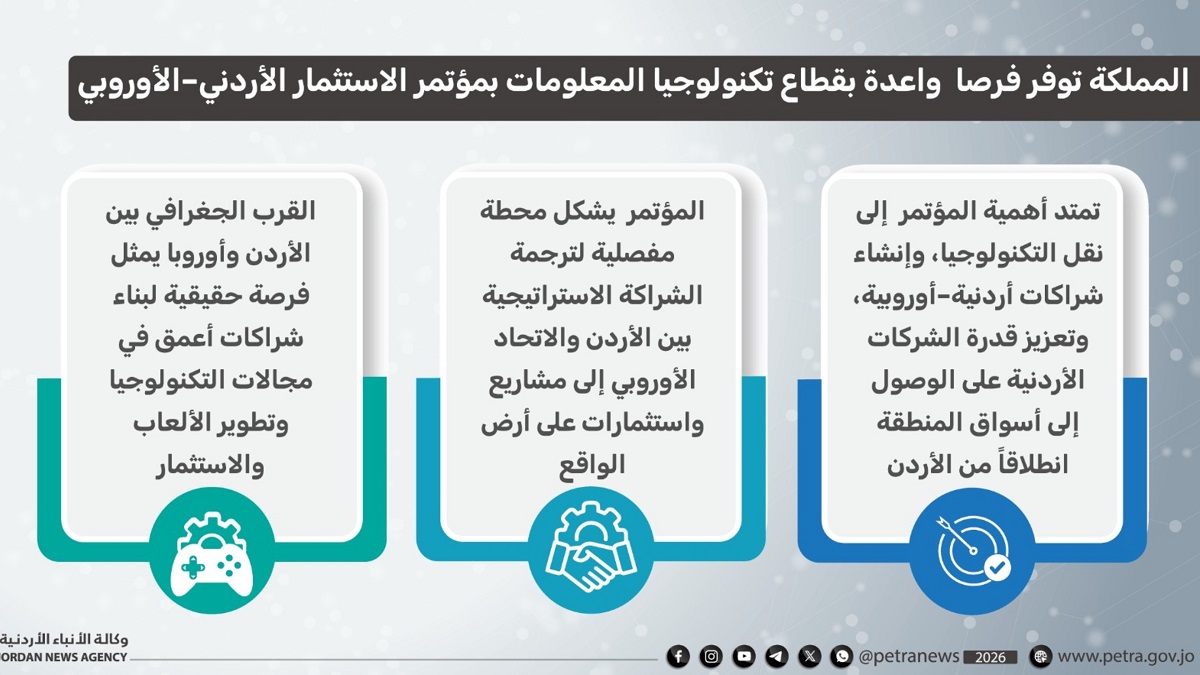
Amman, Oct. 4 (Petra) — Jordan’s technology industry sees the
upcoming Jordan-EU Investment Conference as an opportunity to bring
European capital, technology and research operations into the Kingdom
while giving local companies a stronger route into European and
regional markets.
Industry leaders told the Jordan News Agency (Petra) that Jordan’s
skilled technology workforce, competitive operating costs and
proximity to Europe could support investment in software development,
artificial intelligence, cybersecurity, cloud computing, financial
technology and gaming.
The Nov. 19 conference will be held under the Jordan-EU Strategic and
Comprehensive Partnership launched in early 2025 and will showcase
investment opportunities in the digital economy alongside renewable
energy, clean technology, industry, logistics and infrastructure.
His Majesty King Abdullah II and European Commission President Ursula
von der Leyen witnessed the signing of the partnership agreement in
Brussels in January 2025. The EU announced a €3 billion financial and
investment package for Jordan for the 2025-2027 period in support of
the partnership’s objectives.
Falcon Soft CEO Haitham Rawajbeh said the conference should be viewed
not only as a platform for attracting investment but also as a route
for technology transfer, joint ventures and greater access for
Jordanian companies to regional markets.
He said Jordan could pitch itself to European investors as a regional
base for software development, enterprise resource planning systems,
cloud computing, AI and IT and business-process outsourcing.
The Kingdom could also attract European companies to establish
research and development centers and laboratories specializing in
software, AI and data analytics, helping shift its role from a
technology market toward a producer and exporter of digital
solutions, Rawajbeh said.
He identified data centers, cloud infrastructure and cybersecurity
operations centers as further investment opportunities, particularly
facilities capable of serving both Jordan and surrounding markets.
Potential partnerships could extend to data protection and disaster
recovery, as well as digital payments, open banking, regulatory
technology, anti-fraud systems and financial platform integration, he
added.
Rawajbeh also pointed to health and education technology, including
telemedicine, electronic health records, medical AI, digital learning
and vocational training platforms, as areas where products developed
in Jordan could be scaled across regional markets.
He proposed establishing a joint Jordanian-European technology fund
to invest in Jordanian startups with the potential to expand into
Europe and the wider region, while linking them to European
accelerators, companies and investment funds.
Fadi Qutaishat, chairman of the Information and Communications
Technology Association of Jordan (int@j), said placing the digital
economy among the conference’s priority sectors reflects the
investment potential of Jordan’s technology industry and its pool of
specialized talent.
He said the conference represents an important test of translating
the Jordan-EU strategic partnership into tangible projects and
investments.
Qutaishat linked the opportunity to the “Jordan: A Hub for
Technology” strategy, which aims to attract international technology
companies and strengthen the Kingdom’s role as a base for exporting
digital services and solutions.
He identified green energy, water and financial technology as areas
where Jordanian and European companies could combine expertise.
Jordan could also serve as a platform for providing digital services
to reconstruction projects across the region, he said.
Venture capital is another priority, Qutaishat added, arguing that
European investment could give Jordanian startups the financing and
networks needed to expand into European markets.
He stressed that the conference’s outcomes should include practical
programs for digital skills development and easier market access for
Jordanian companies and professionals.
Maysalward founder and CEO Nour Khrais said the rapidly growing
regional video game industry provides another potential bridge
between Jordan and Europe.
Jordan offers talent and experience in game development, while
European companies bring advanced technology, capital and
international publishing networks, he said.
Khrais said combining those strengths could move cooperation beyond
outsourcing toward joint product development, intellectual property
creation and shared access to regional and global markets.
//Petra// RZ