Jordan’s Q2 2026 GDP Expands 3.0%, Outperforming Regional Headwinds, International Forecasts
ENV-KUWAIT-SUSTAINABLITYKuwait strengthens environmental sustainability through strategic initiativesBy Zahra Al-Kadhmi

HLT-KUWAIT-SURGERYKuwait advances health sector with robotic, remote surgeryBy Mohammad Al-Moseb

Saudi Arabia’s Voluntary Carbon Market Fuels the Shift to a Low-Carbon

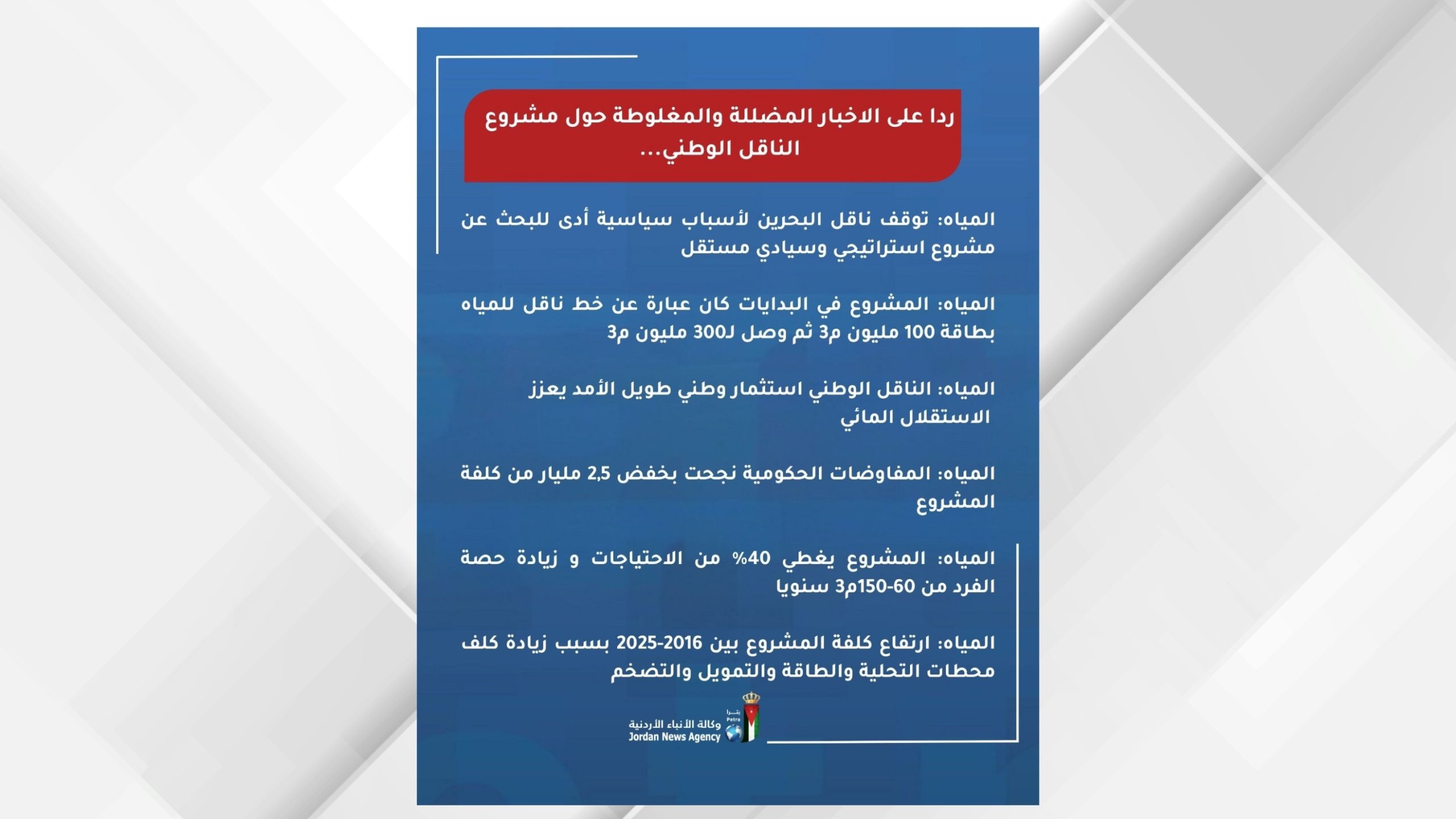
Amman, July 5 (Petra) — The Ministry of Water and Irrigation has reaffirmed the strategic importance of the National Water Carrier Project, describing it as a long-term national investment essential to strengthening Jordan’s water independence and economic resilience, while responding to what it said were misleading reports regarding the project’s cost and implementation.
In a statement issued Sunday, the ministry said the suspension of the Red Sea-Dead Sea Conveyance Project for political reasons prompted the government to pursue an independent national alternative capable of securing sustainable water supplies.
It explained that the National Water Carrier Project was initially conceived in 2016 as a pipeline with an annual capacity of 100 million cubic meters before being gradually expanded to 150 million cubic meters and ultimately to 300 million cubic meters to meet the country’s growing water needs.

According to the ministry, the project is expected to secure around 40 percent of Jordan’s water requirements through 2040 while increasing annual per capita water availability from approximately 60 cubic meters to 110 cubic meters.
The ministry said the increase in the project’s estimated cost between 2016 and 2025 reflects higher desalination, energy and financing costs, in addition to cumulative inflation over the period, stressing that the project remains the most economically viable option for securing a sustainable national water source.
It added that the National Water Carrier will reduce long-term costs across productive sectors, support economic growth, encourage investment and strengthen Jordan’s self-reliance in one of its most critical strategic resources.
Describing the initiative as the largest water project in Jordan’s history, the ministry said it carries an estimated capital cost of approximately $5.8 billion and is financed through a partnership involving 29 international financing institutions.
The statement said the Treasury has allocated $722 million to the project, representing the largest direct government financing commitment for a single project, while Jordanian banks are contributing approximately $1.1 billion. The Social Security Investment Fund is financing 15 percent of the project to help lower financing costs, reduce the cost of water production and mitigate financial risks.
The ministry stressed that the financing model spreads the project’s financial obligations over time, arguing that while the government bears the initial investment burden, the project should be viewed as a strategic investment rather than a financial liability because of its long-term contribution to water security and economic development.
It said the project will help improve water supply schedules for citizens while creating opportunities for industrial, agricultural and investment projects that depend on reliable water resources.
The ministry also disclosed that the government succeeded in reducing the project’s projected overall cost by approximately $2.5 billion through extensive negotiations with financing partners.
It noted that a water tariff reform program extending through 2029 has been introduced to ensure equitable pricing across different consumer groups while safeguarding social protection.
The ministry warned that the water sector’s debt currently exceeds JD4 billion, accounting for around 12 percent of Jordan’s total public debt, adding that it could rise to approximately JD15 billion by 2040 if reforms are not implemented, water losses are not reduced and financial sustainability measures are not maintained.
The statement emphasized that the National Water Carrier Project has been implemented in accordance with high standards of transparency and governance throughout its planning, evaluation and procurement phases, helping secure broad international financing and investor confidence.
It added that the project will raise annual per capita water availability from approximately 60 cubic meters to around 110 cubic meters, although this remains significantly below the global water poverty threshold of 500 cubic meters per person.
The ministry called on media outlets and the public to exercise responsibility when addressing the project, citing its strategic importance to Jordan’s long-term water and economic security.
//Petra// RZ