Jordan’s Q2 2026 GDP Expands 3.0%, Outperforming Regional Headwinds, International Forecasts
ENV-KUWAIT-SUSTAINABLITYKuwait strengthens environmental sustainability through strategic initiativesBy Zahra Al-Kadhmi
HLT-KUWAIT-SURGERYKuwait advances health sector with robotic, remote surgeryBy Mohammad Al-Moseb

Saudi Arabia’s Voluntary Carbon Market Fuels the Shift to a Low-Carbon

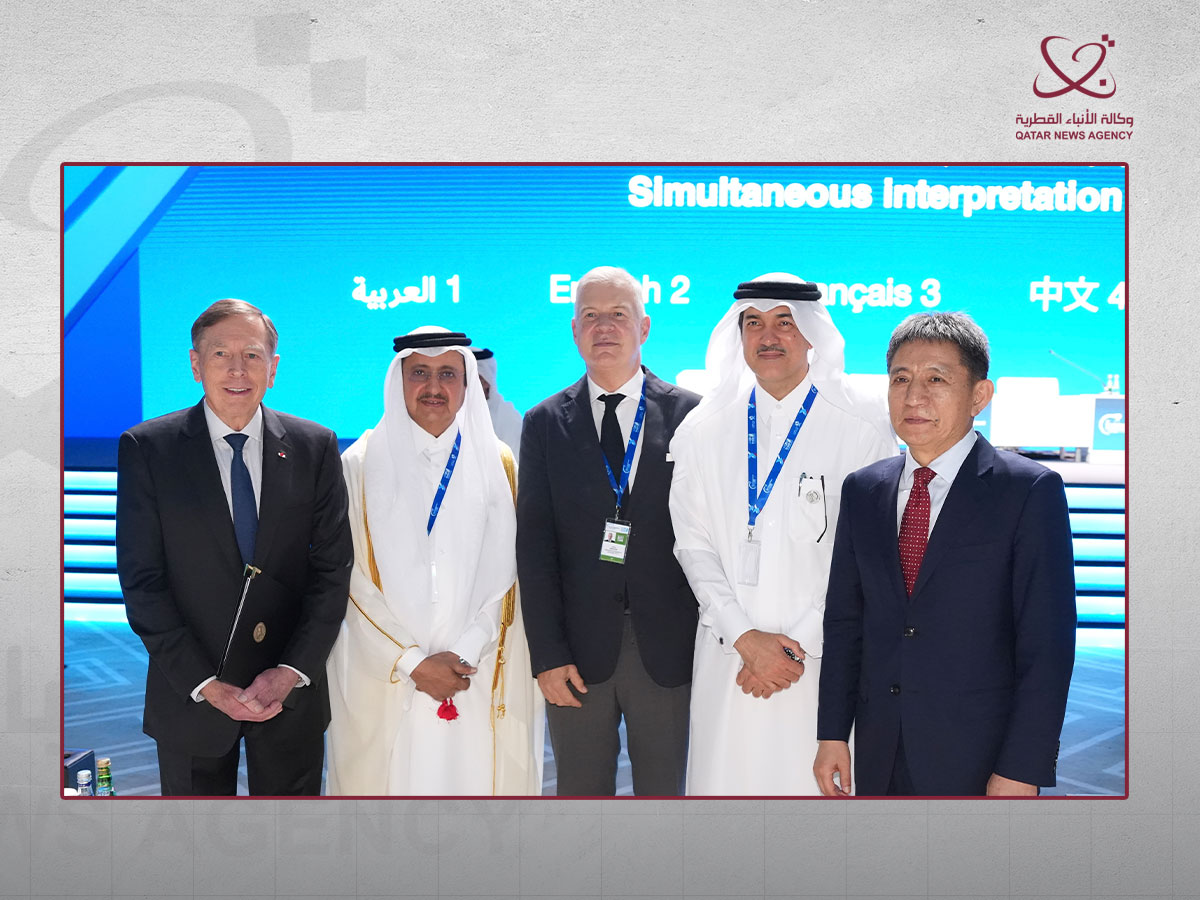
Doha, October 25 (QNA) – A panel discussion held Sunday as part of the 9th World Investment Forum, hosted by the State of Qatar in partnership with the United Nations Conference on Trade and Development (UNCTAD), explored ways to enhance the resilience of global value chains and expand opportunities for countries and companies to participate in them.
The session featured the participation of HE Minister of State for Foreign Trade Affairs at the Ministry of Commerce and Industry Dr. Ahmed bin Mohammed Al Sayed, HE Director-General of the World Trade Organization (WTO) Ngozi Okonjo-Iweala, Secretary General of the International Chamber of Commerce John Denton, and Chairman of the KKR Global Institute and Chairman of KKR Middle East General David Petraeus.
In his remarks during the session, HE Dr. Ahmed bin Mohammed Al Sayed said that the State of Qatar has demonstrated great resilience in facing the crisis over the past few months, emphasizing its commitment to further openness and deeper engagement with the world.
His Excellency indicated that Qatar’s strategy in this regard focuses on securing import supply chains and expanding access to foreign markets, both through trade and investment agreements with the Gulf Cooperation Council (GCC) states and through direct engagement, in addition to increasing the export of goods and services.
HE the Minister of State for Foreign Trade Affairs at the Ministry of Commerce noted that the Third National Development Strategy prioritizes sectors such as logistics, advanced manufacturing, technology, and AI, while encouraging investors to focus on trade facilitation and digital commerce.
For her part, HE Ngozi Okonjo-Iweala said that global trade in goods and services reached a record high of USD 35 trillion last year, despite tariffs, unilateral measures, and disruptions in the Strait of Hormuz, the Red Sea, and the Black Sea. She noted that while the organization had projected 1.9 percent growth in the trade of goods for 2026, the growth recorded in the first half reached 3.5 percent, nearly double the initial forecast.
Her Excellency noted that these indicators reflect resilience rather than robustness. This is the result of efforts by policymakers and companies that have turned to alternative routes, including pipelines and overland corridors, albeit at a higher cost, encompassing expenses for transport, insurance, and shipping, alongside the limited capacity of berths at several ports. She further pointed out that 72 percent of global trade continues to be conducted in accordance with the rules of the WTO.
Her Excellency noted that the trade in AI goods, referring to the physical hardware upon which AI systems are built, rather than software or services, accounted for approximately 42 percent of the growth in the trade of goods in 2025, and nearly 50 percent in the first half of 2026.
Her Excellency said that 70 percent of investment in this field is concentrated in North America, while most supplies originate from East Asia, adding that the top ten exporters of AI-related goods account for 85 percent of exports and 80 percent of imports.
Her Excellency urged for investment in ports around the Cape of Good Hope, as well as in land bridges, alternative pipelines, and port terminal capacity, noting that she had discussed with the President of the World Bank the allocation of USD 12 billion, recently mobilized from private capital, toward these projects.
For his part, Secretary General of the International Chamber of Commerce John Denton observed that geopolitical tensions, tariffs, and protectionist stances do not necessarily signify an actual decoupling of trade. The private sector continues to maintain connections between economies and is reconfiguring supply chains, albeit through a complex process.
He indicated that the International Chamber of Commerce, which operates in 170 countries, 70 percent of which are in the Global South, facilitates approximately USD 17.5 trillion in global economic activity annually.
He pointed out that a survey covering approximately 135 chambers of commerce revealed that uncertainty is the primary obstacle facing businesses, a costly one at that, with losses in economic activity reaching USD 280 billion last year and projected to climb to about USD 600 billion in 2026.
Denton called for addressing these challenges through digital transformation, including the legal recognition of electronic bills of lading. He noted that the ASEAN Digital Economy Framework Agreement (DEFA) could generate 500,000 jobs in Indonesia through small and medium-sized enterprises (SMEs).
The Secretary-General of the International Chamber of Commerce warned that a narrow interpretation of digital sovereignty, equating it to the restriction of data flows, is not an optimal choice for Africa and Latin America.
In turn, General Petraeus said that over the past fifteen years, the world has shifted from a phase of benign globalization, characterized by the lowering of barriers to trade, investment, capital flows, and technology, to a phase marked by renewed great-power competition, rising trade barriers, and a trend toward regional blocs.
He indicated that supply chains no longer offer the same levels of reliability as before, prompting companies to adopt precautionary logistics strategies, such as maintaining reserve inventories, rather than relying on immediate, “just-in-time” procurement.
He anticipated that the GCC states would invest heavily in strengthening their resilience and defenses, and in developing alternatives to contested corridors, including the Bab Al Mandab Strait.
He added that KKR, where he serves as Chairman of the KKR Global Institute and Head of KKR Middle East, will play a major role in these investments. The firm has been investing in the region for many years and now views it as an attractive investment destination, rather than merely a source of funding.
HE International Trade Representative of China Li Chenggang opened the session by noting that the development of global value chains faces three challenges: the rise of protectionism and unilateralism, the growing risk of marginalizing developing countries, especially the least developed ones, and the fragmentation of international investment rules.
Regarding the second point, His Excellency drew upon the World Investment Report 2026, which, according to him, indicates a further decline in the share of global industrial investment going to low-income countries. He added that the WTO’s Investment Facilitation for Development (IFD) Agreement has not yet entered into force.
His Excellency noted that China’s outward foreign investment has remained among the top three globally for nine consecutive years. By the end of 2025, Chinese enterprises had established over 50,000 companies across more than 190 countries and regions, contributing over USD 300 billion in taxes to host nations and employing 2.965 million foreign workers.
Concluding remarks, he called for upholding multilateralism, accelerating the entry into force of the IFD, maintaining openness and open-source approaches in emerging industries such as AI, and orienting value chains toward development in a manner that serves the countries of the Global South. (QNA)