ENV-KUWAIT-SUSTAINABLITYKuwait strengthens environmental sustainability through strategic initiativesBy Zahra Al-Kadhmi

HLT-KUWAIT-SURGERYKuwait advances health sector with robotic, remote surgeryBy Mohammad Al-Moseb

Saudi Arabia’s Voluntary Carbon Market Fuels the Shift to a Low-Carbon

Under UAE President’s directives, UAE launches urgent relief response for Ghana flood victims

Amman, June 30 (Petra) — Jordan’s economy continues to advance
steadily despite regional instability, supported by its resilience,
adaptability, and ability to turn challenges into opportunities.
The economy’s growth trajectory has been underpinned by the support
of His Majesty King Abdullah II, whose policies have strengthened
high-value-added sectors that drive economic growth, as well as by
government measures and decisions that have accelerated the
implementation of the Economic Modernization Vision and fostered a
business environment conducive to attracting investment.
Jordan’s economy exceeded the World Bank’s latest forecast, which
projected growth of 2.7% this year, rising to 2.9% in 2027. Instead,
the economy expanded by 2.9% in the first quarter of this year.
Economists interviewed by the Jordan News Agency (Petra) said the
first-quarter growth estimate reflects the strength of the national
economy and its ability to maintain growth despite regional
challenges and instability.
Former minister Yousef Mansour said recent economic indicators point
to growth across several sectors, led by manufacturing. Industrial
activity generally delivered positive results, while the agricultural
sector also improved despite weather-related challenges affecting
some activities.
He said the prevailing optimism stems from the government’s focus on
stimulating economic growth and launching projects that support
economic activity and create jobs, rather than concentrating solely
on economic challenges and public debt.
Mansour said he expects growth to continue improving next year,
particularly if regional tensions ease. He added that continued
government efforts to stimulate the economy, settle outstanding
financial obligations, and launch productive projects would
strengthen economic activity and increase productivity.
He also said the overall assessment of the government’s performance
remains positive, with growing optimism about its ability to deliver
further achievements in the coming period.
Fathi Al-Jaghbir, president of the Jordan Chamber of Industry, said
preliminary estimates issued by the Department of Statistics for the
first quarter of 2026 confirm the pivotal role of the industrial
sector in supporting economic growth.
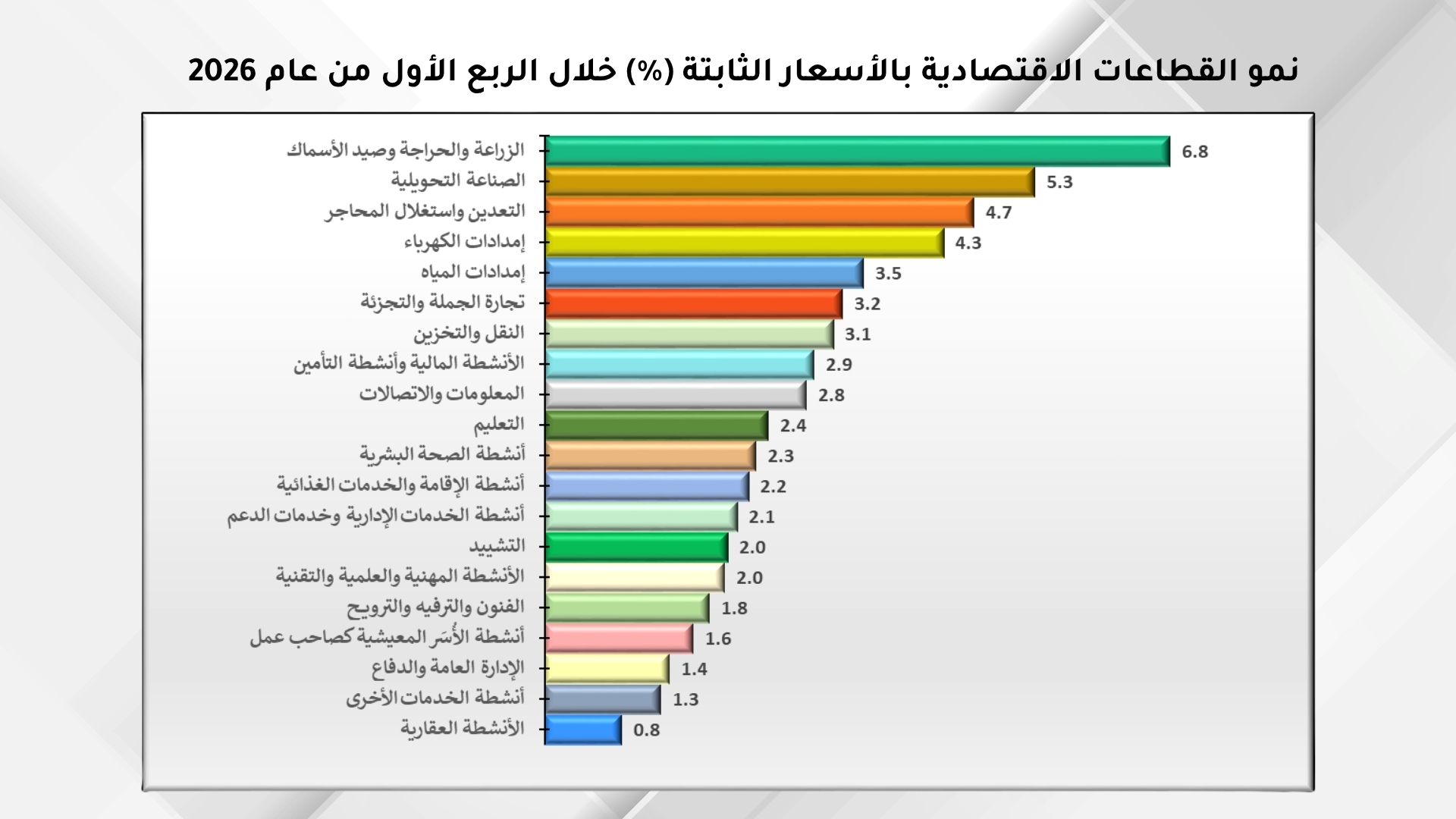
He said the manufacturing sector expanded by 5.3%, contributing 0.86
percentage points to the overall economic growth rate of 2.9%, making
it the largest contributor to growth during the quarter.
Al-Jaghbir said the results demonstrate the resilience of Jordan’s
economy and its ability to sustain growth despite regional challenges
and unrest, underscoring the country’s success in maintaining
economic stability and strengthening investor confidence. He also
attributed the performance to government policies and measures that
have effectively supported the productive sector, transformed
challenges into opportunities, and strengthened cooperation between
the public and private sectors in implementing the Economic
Modernization Vision.
He added that the figures also highlight the resilience of Jordan’s
industrial sector and its ability to continue expanding despite
regional and global challenges while confirming the success of
industrial companies in enhancing competitiveness and expanding
production and exports, reinforcing industry’s role as the engine of
the national economy.
Maintaining this positive performance, he said, requires continued
implementation of the Economic Modernization Vision, improving the
sector’s competitiveness, simplifying procedures, supporting exports
and increasing local content to enable industry to continue leading
economic growth in the coming years.
Al-Jaghbir said the industrial sector now represents the cornerstone
of Jordan’s economy, contributing about 24% of gross domestic product
directly and around 45% directly and indirectly. It also accounts for
nearly 95% of national exports, reinforcing its role in achieving
sustainable growth, creating jobs and increasing value added in the
economy.
Economic expert Adli Qandah said the increase in real gross domestic
product growth is a positive indicator of improved economic
performance. Achieving growth despite geopolitical challenges and
regional instability reflects the economy’s resilience and its
ability to absorb external shocks.
He said the leading contribution of agriculture, industry, mining and
electricity reflects diversified sources of economic strength.
Agriculture benefited from relative improvements in production and
demand, while industry and mining were supported by stronger external
demand and higher global prices, particularly for phosphate, potash
and certain manufacturing industries. The electricity sector also
benefited from increased economic activity and stronger consumption
by productive and service sectors.
Qandah said economic, fiscal and monetary policies indirectly
supported the improvement by maintaining monetary stability and the
exchange rate, keeping inflation at manageable levels, directing part
of public spending toward capital and infrastructure projects, and
gradually improving the business environment, thereby strengthening
investor confidence.
He said the impact of the improvement varied across productive
sectors, with export-oriented and industrial sectors benefiting more
significantly, while gains remained limited in some
lower-productivity service sectors.
Economic and investment expert Wajdi Makhamreh said the growth
confirms that Jordan’s economy has become more resilient to external
challenges. At a time when the region is experiencing heightened
uncertainty due to wars and geopolitical tensions, Jordan has
maintained an upward growth trajectory, reflecting the strength of
government economic policies, the resilience of state institutions,
and their ability to manage risks.
He said the growth was driven by productive sectors rather than
temporary or consumption-based activities. Higher growth rates in
agriculture, manufacturing, mining and electricity indicate that the
economy is generating genuine value added, strengthening production
and exports and enhancing overall competitiveness.
Makhamreh said government economic policies have begun to yield
results, with coordination between fiscal and monetary policies,
alongside measures supporting the private sector, investment and
production, helping sustain economic activity despite the difficult
regional environment.
He said growth across a broad range of economic activities is an
especially positive sign. When most sectors expand simultaneously, it
reflects a broader economic base rather than reliance on a single
sector, making growth more sustainable and less vulnerable to
fluctuations.
Recording economic growth of 2.9% under complex regional conditions,
he added, represents more than just an economic figure; it
demonstrates that Jordan’s economy possesses increasing resilience
and a greater capacity to adapt to crises.
Makhamreh said that if economic reforms continue and the investment
climate improves, Jordan will be able to build on this performance to
achieve higher and more sustainable growth in the coming years, with
direct benefits for citizens’ living standards.
//Petra// AF