Saudi Arabia’s Voluntary Carbon Market Fuels the Shift to a Low-Carbon

Under UAE President’s directives, UAE launches urgent relief response for Ghana flood victims

Combating Desertification and Drought: Qatar a Model in Preserving Natural Resources, Establishing Environmental Stability
UAE allocates US$30 million for emergency humanitarian response in El Obeid, calls for civilian protection, safe humanitarian aid access in Sudan

Amman, July 22 (Petra) — The Arab Regional Conference to Follow up
on the Outcomes of the Global Disability Summit 2025 concluded on
Wednesday in Amman, under the patronage of Prince Mired bin Raad,
Chief Chamberlain and President of the Higher Council for the Rights
of Persons with Disabilities (HCD).
The conference gathered ministers, officials, experts, and
representatives from organizations of persons with disabilities, as
well as Arab, regional, and international bodies, to discuss
accelerating the implementation of commitments stemming from the
Global Disability Summit, primarily the Amman-Berlin Declaration, and
strengthening Arab cooperation to translate these commitments into
action.
The event was co-organized by the HCD, the League of Arab States’
Social Development and Policies Department, the Ministry of Social
Development, the International Disability Alliance (IDA), and the
German Agency for International Cooperation (GIZ), with support from
CBM (Christoffel-Blindenmission).
The second day featured two main sessions. The first focused on
inclusive education, exploring ways to develop inclusive educational
policies, improve access to education for persons with disabilities,
and share Arab and international best practices. Participants
included representatives from the Committee on the Rights of Persons
with Disabilities, the Ministry of Education, the Royal Academy for
Inclusive Education, UNESCO, and UNICEF.
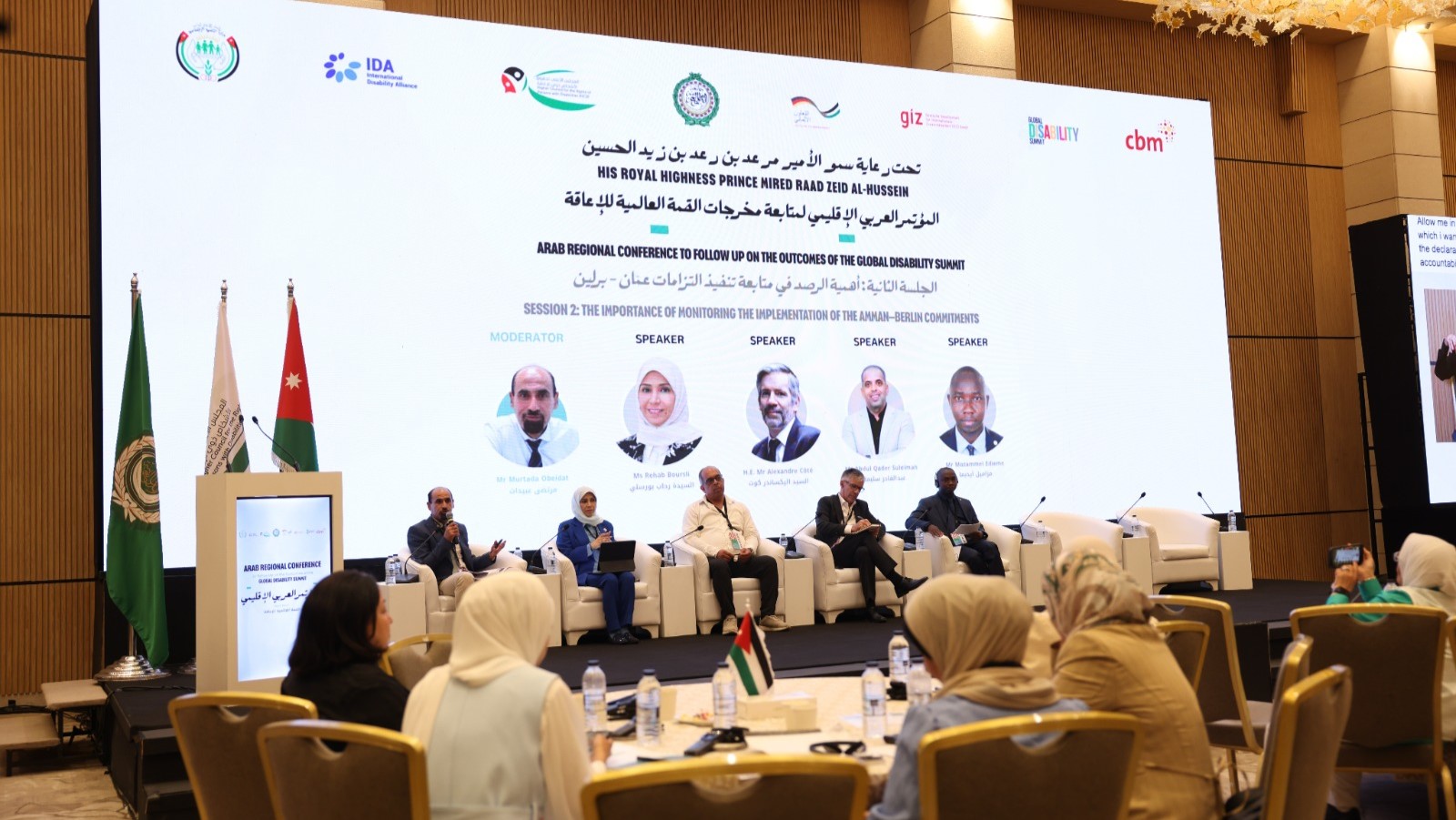
The second session highlighted monitoring systems for tracking the
Amman-Berlin Declaration commitments, emphasizing data-driven
evaluation frameworks and the role of disability organizations in
monitoring national implementation to enhance accountability and
measure policy impact.
Two side events were also held: one on inclusive employment and
private sector partnerships and another on digital accessibility in
the Middle East and North Africa, showcasing regional initiatives
aimed at ensuring equal access to digital services and technologies.
At the closing session, Tareq Nabulsi, Minister Plenipotentiary and
Director of Social Development and Policies at the League of Arab
States, noted that the conference served as a key regional milestone.
He stated that the Arab League Secretariat will coordinate with the
Council of Arab Ministers for Social Affairs to submit the conference
recommendations for approval at its upcoming executive meeting in
October to secure political support across Arab states.
Sheikha Aisha bint Mubarak Al Thani, Advisor at Qatar’s Ministry of
Social Development and Family, highlighted that Qatar’s hosting of
the 4th Global Disability Summit in 2028 reflects its commitment to
advancing the rights of persons with disabilities. She announced that
Qatar has begun organizational preparations, with preparatory
meetings set for 2027 and an international forum planned for December
2026. The 2028 summit will be held in a hybrid format to ensure broad
participation.
Nawaf Kabbara, President of the International Disability Alliance and
the Arab Organization of Persons with Disabilities, called for moving
from commitments to action, emphasizing that the Amman-Berlin
Declaration must produce tangible changes. He urged Arab nations to
adopt clear national plans, allocate necessary resources, and embody
the principle of “Nothing About Us Without Us.”
HCD Secretary-General Muhannad Al-Azza emphasized that the conference
aimed to maintain momentum following the Global Disability Summit
2025 and ensure commitments translate into continuous execution
rather than remaining symbolic. He expressed hope that concrete
progress would be made ahead of the upcoming summit in Doha.
In their final recommendations, participants called on Arab states to
report their implementation progress to the Arab League and adopt the
Second Arab Decade for Persons with Disabilities (2023–2032) as the
primary framework for the Amman-Berlin Declaration.
Recommendations also called for enhanced disaggregated data
collection, expanded partnerships with the private sector through the
Union of Arab Chambers to foster inclusive employment, and a greater
role for media in promoting disability rights.
Participants expressed their gratitude to Jordan, its leadership, and
its government for hosting the event, praising Prince Mired’s
patronage and the organizing efforts of the HCD and the Ministry of
Social Development.
//Petra// AF