Saudi Arabia’s Voluntary Carbon Market Fuels the Shift to a Low-Carbon

Under UAE President’s directives, UAE launches urgent relief response for Ghana flood victims

Combating Desertification and Drought: Qatar a Model in Preserving Natural Resources, Establishing Environmental Stability

UAE allocates US$30 million for emergency humanitarian response in El Obeid, calls for civilian protection, safe humanitarian aid access in Sudan

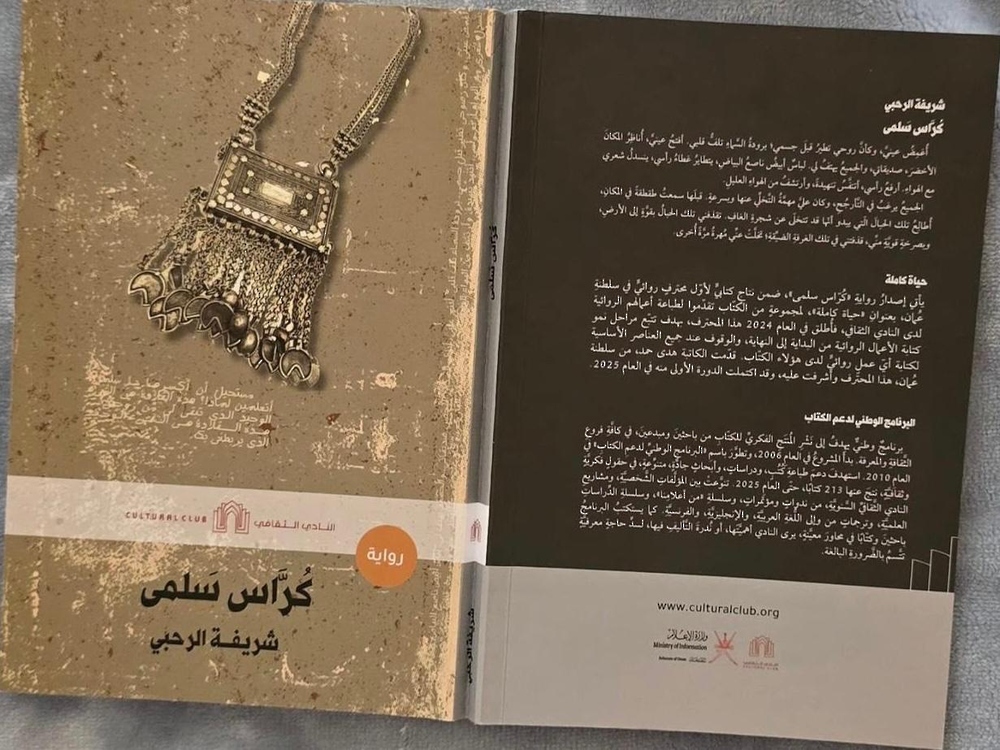
“Salma’s
Notebook”: A Novel Chronicling the Meaning of Struggle and Giving
Muscat,
14 Sep 2026 (ONA) — The novel “Salma’s Notebook” by author Sharifa Salim
Al Rahbi delves into the social fabric of certain girls’ lives in the 1970s
within the Omani milieu, tracing the reasons for their deprivation of education
and how they defied hardships to ultimately achieve their goals in life.
The
novel was released in its first edition for 2026, within the National Programme
for Supporting the Book, implemented by the Cultural Club, from which a number
of male and female writers have benefited, having excelled in enriching the
Omani library with a diverse intellectual output.
The
novel spans 237 pages distributed across 19 chapters, with its events revolving
around a girl named “Salma” who lives a childhood unlike that of
other girls, her story beginning in an isolated house far from the village and
friends, where she finds solace in inventing an imaginary friend with whom she
roams a world of imagination and beauty, visiting her from time to time at
home, at the aflaj “ancient irrigation system” and at school.
The
novel traverses Salma’s life from the outset of her stolen childhood within her
home, between love and cruelty, and between a fatherhood both present and
absent at once. The protagonist Salma becomes attached to knowledge and school
from the moment schools first opened, yet the dream quickly fades, and the
events of the story grow and escalate, oscillating between past and present, to
reveal the reasons behind that isolation.
The
novel also sheds light on an important facet of the social transformations in
the Omani milieu, such as the opening of schools for boys and then for girls,
in addition to the arrival of electricity. The events highlight Salma’s
profound attachment to books and her love of school, even though life and
family circumstances prevented her from continuing her education.
The
events escalate chronologically after Salma’s marriage at an early age, like
the other girls of her era, as she embarks upon experiences and events beyond
her years, and begins to record her memories and the events of her life in
“Salma’s Notebook.”
Salma
recounts her memories in the falaj “water channel for irrigation” and her
unforgettable name, “Daughter of the Jinn,” followed by the contours
of the place she traverses back and forth to school and her daily slumber on
the bus.
The
events grow more fraught after she is forced out of the school benches and into
married life and early motherhood.
The
author leaves us “Salma’s Notebook” to carry us back to some of the
memories of our own childhood, between the channel of the falaj, the bustle of
the village and the hardship of life in times past. It is, as it were, a gift
to the reader of the seventies and eighties as they recall some of what remains
lodged in memory from a childhood folded away by time, closing the pages of the
notebook as though they had lived the very events themselves.
—
Ends/Khalid