
ENV-KUWAIT-SUSTAINABLITYKuwait strengthens environmental sustainability through strategic initiativesBy Zahra Al-Kadhmi

HLT-KUWAIT-SURGERYKuwait advances health sector with robotic, remote surgeryBy Mohammad Al-Moseb

Saudi Arabia’s Voluntary Carbon Market Fuels the Shift to a Low-Carbon

Under UAE President’s directives, UAE launches urgent relief response for Ghana flood victims

Amman, July 31 (Petra)– The Fuel Pricing Committee on Friday decided
to keep retail prices of major petroleum products unchanged for
August, despite a significant rise in global fuel prices driven by
renewed regional political tensions.
During its regular monthly meeting, the committee reviewed
international petroleum product prices for July compared with June
and found a notable increase in average prices, particularly for
diesel and kerosene. The rise was attributed to renewed geopolitical
tensions in the region during the second half of July, which pushed
up global fuel prices.
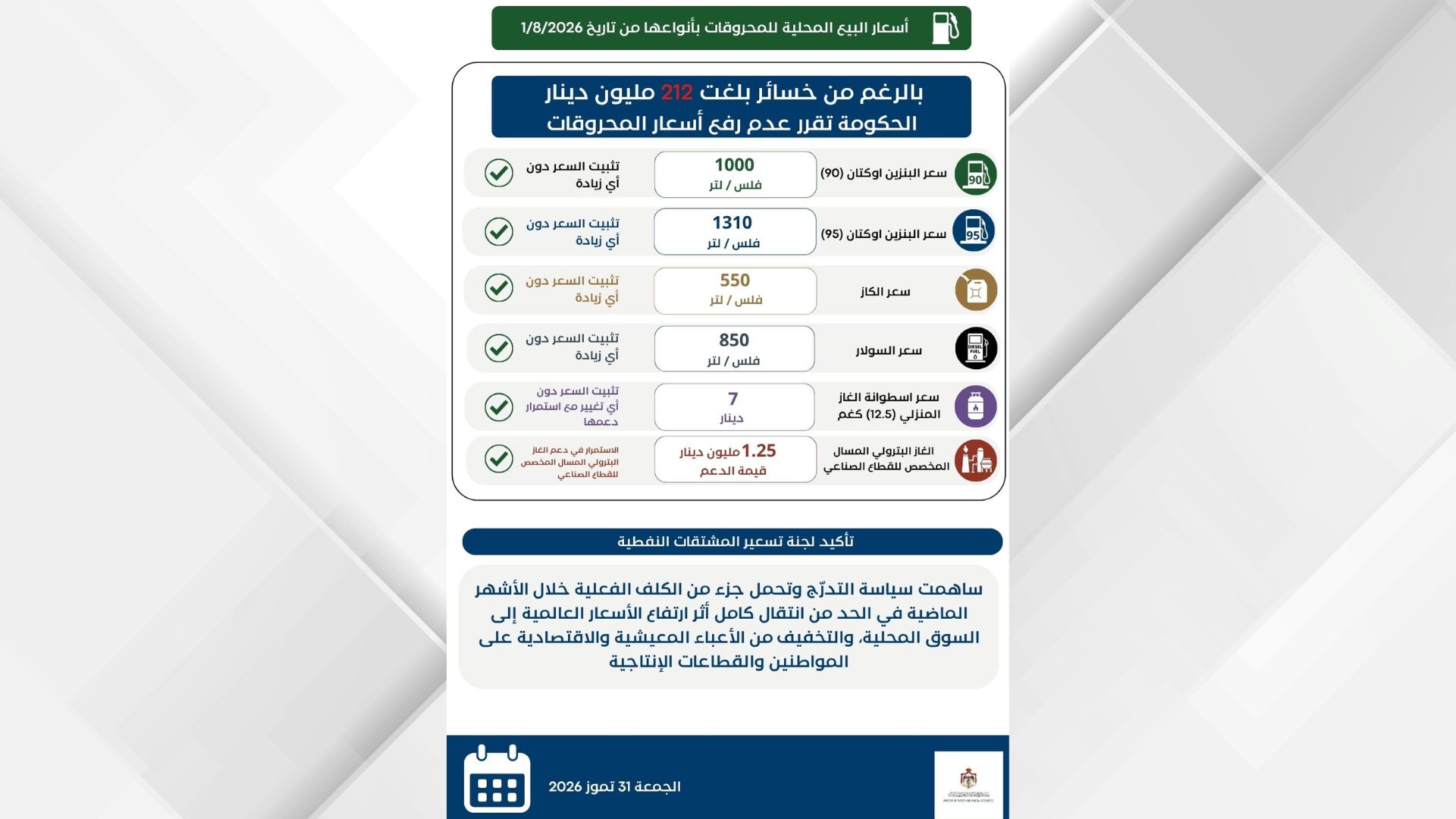
Following government directives, the committee decided to maintain
August fuel prices at the same levels as in July. The prices are set
at JD1.000 per litre for Octane 90 gasoline, JD1.310 per litre for
Octane 95 gasoline, 850 fils per litre for diesel, and 550 fils per
litre for kerosene.
The committee also kept the price of the 12.5-kilogram household LPG
cylinder unchanged at JD7, while continuing support for liquefied
petroleum gas supplied to the industrial sector, with subsidies
amounting to JD1.25 million.
The committee said the decision reflects the government’s policy of
shielding citizens and economic sectors from sharp fluctuations in
global energy markets. It noted that the government has continued to
gradually absorb increases in international fuel prices rather than
passing the full cost on to consumers.
According to the committee, domestic fuel prices have not reflected
the actual costs in recent months. Since the onset of the current
crisis through the end of July, the government has borne
approximately JD212 million in subsidies and price differentials,
including support for household LPG cylinders.
The committee added that this gradual pricing approach has helped
cushion the impact of higher global fuel prices on the domestic
market, easing financial pressures on households and productive
sectors. It reiterated that local fuel prices are calculated based on
the monthly average of international petroleum product prices over
the 30 days preceding the pricing decision.
The committee affirmed that it will continue to closely monitor
developments in global crude oil and petroleum product markets to
ensure timely decisions that balance consumer protection, support for
economic sectors, and the preservation of Jordan’s economic and
financial stability.
//Petra// MF