Saudi Arabia’s Voluntary Carbon Market Fuels the Shift to a Low-Carbon

Under UAE President’s directives, UAE launches urgent relief response for Ghana flood victims

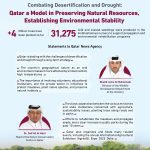
Combating Desertification and Drought: Qatar a Model in Preserving Natural Resources, Establishing Environmental Stability
UAE allocates US$30 million for emergency humanitarian response in El Obeid, calls for civilian protection, safe humanitarian aid access in Sudan


Petra, Sept. 7 (Petra) — Jordan Renewable Energy and Energy
Efficiency Fund (JREEEF) of the Ministry of Energy and Mineral
Resources launched a project on Monday to install solar cell systems
on 18 municipal buildings in the southern region after a similar
phase was completed in the north.
During the launch event, the fund reviewed its previous experience in
northern municipalities, where the systems helped cut operating costs
and electricity bills, drawing on field expertise gained there to
guide the current southern phase.
The project reflects the government’s commitment to extending
renewable energy programs to all regions of the kingdom, said the
Ministry’s Secretary-General Amani Alazzam.
The move to the southern phase, she pointed out, underscores the
ministry’s commitment to providing practical solutions that ease
municipalities’ financial burdens, noting that lower energy costs
would let municipalities redirect resources toward better services
for residents.
She highlighted the importance of partnership with Italy’s Ministry
of Environment and Energy Security (MASE) in supporting clean energy
transition projects, reducing carbon emissions and training municipal
staff to operate and manage the systems according to technical
standards.
JREEEF Executive Director Rasmi Hamzeh said the fund will continue
programs targeting service and development sectors, describing the
southern solar project as a key step in expanding renewable energy
use and improving energy efficiency in public institutions.
The project is part of a national program covering 104
municipalities, involving the installation of solar systems on 188
municipal buildings with a combined capacity of about 3.4 megawatts.
The program is expected to save about JD550,000 annually in
electricity costs, cut carbon emissions by about 3,838 tons of CO2 a
year, and train more than 550 municipal staff through two training
packages.
//Petra// NQ