Saudi Arabia’s Voluntary Carbon Market Fuels the Shift to a Low-Carbon
Under UAE President’s directives, UAE launches urgent relief response for Ghana flood victims

Combating Desertification and Drought: Qatar a Model in Preserving Natural Resources, Establishing Environmental Stability
UAE allocates US$30 million for emergency humanitarian response in El Obeid, calls for civilian protection, safe humanitarian aid access in Sudan

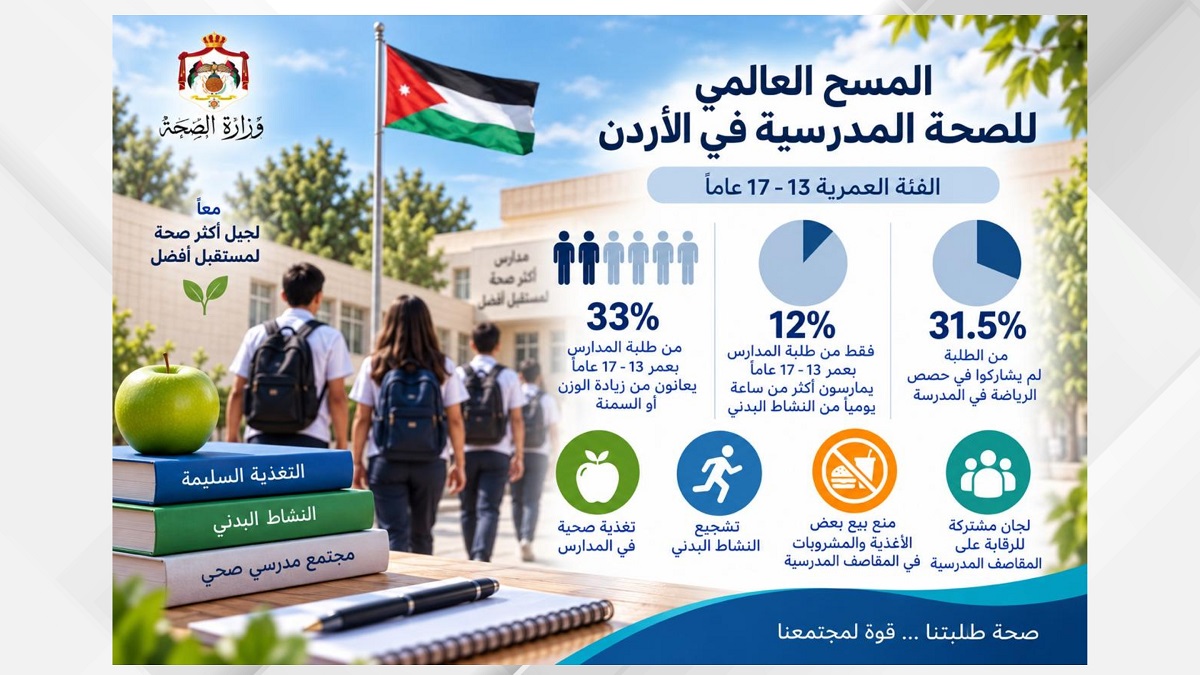
Amman, Sept. 14 (Petra) — Nearly one-third of school students aged
13 to 17 are overweight or obese, with the rate rising to 42.5
percent among private-school students, according to a national school
health survey that has prompted new measures on food and physical
activity in schools.
Health Minister Ibrahim Al-Bdoor said the Global School-based Student
Health Survey found that 32.9 percent of students in the age group
were above a healthy weight, including 20.8 percent who were
overweight and 12.1 percent who were obese.
The prevalence of overweight stood at 30.3 percent among
public-school students, compared with 42.5 percent in private
schools.
The survey also revealed low levels of physical activity. Just 12
percent of students exercised for more than 60 minutes a day during
the week, while 31.5 percent did not take part in physical education
classes at school.
The survey was conducted by the Ministry of Health and the Ministry
of Education and Human Resources Development with support from the
World Health Organization.
Al-Bdoor said the findings had led the Health Ministry to introduce a
series of measures targeting two of the main risk factors identified
by the survey: unhealthy diets and insufficient physical activity.
New health requirements have been sent to the Education Ministry for
application in school canteens, together with lists specifying which
foods and drinks may be sold to students.
The prohibited items include flavored and processed chips, carbonated
soft drinks, energy drinks, as well as manually prepared drinks and
juices or products containing artificial coloring.
Oversight of school canteens is also being strengthened. The Health
Ministry has asked the Education Ministry and the Jordan Food and
Drug Administration to activate joint technical committees
responsible for carrying out regular inspections.
The committees, which include representatives of the three agencies,
will inspect canteens at public and private schools across the
governorates to check compliance with health standards and approved
food and beverage lists.
The ministry has also called for physical education to be treated as
an integral part of the school day, instructing schools to hold PE
classes regularly across all grade levels rather than replacing them
with other subjects.
It also recommended incorporating light exercise and interactive
activities into morning assemblies and school breaks, expanding
participation in school sports and competitions, and providing safe
and properly equipped spaces for physical activity.
The measures form part of efforts to curb risk factors for
non-communicable diseases by improving students’ diets, increasing
daily movement and promoting healthier habits from an early age.
//Petra// RZ