Saudi Arabia’s Voluntary Carbon Market Fuels the Shift to a Low-Carbon

Under UAE President’s directives, UAE launches urgent relief response for Ghana flood victims

Combating Desertification and Drought: Qatar a Model in Preserving Natural Resources, Establishing Environmental Stability
UAE allocates US$30 million for emergency humanitarian response in El Obeid, calls for civilian protection, safe humanitarian aid access in Sudan

– Investment Minister: Government focus shifts toward turning
policies and opportunities into productive projects and jobs
– 327 projects receive incentives and exemptions, with expected
investment of JD711.2 million
– Development zone investments rise 18.79% to nearly JD6.9 billion
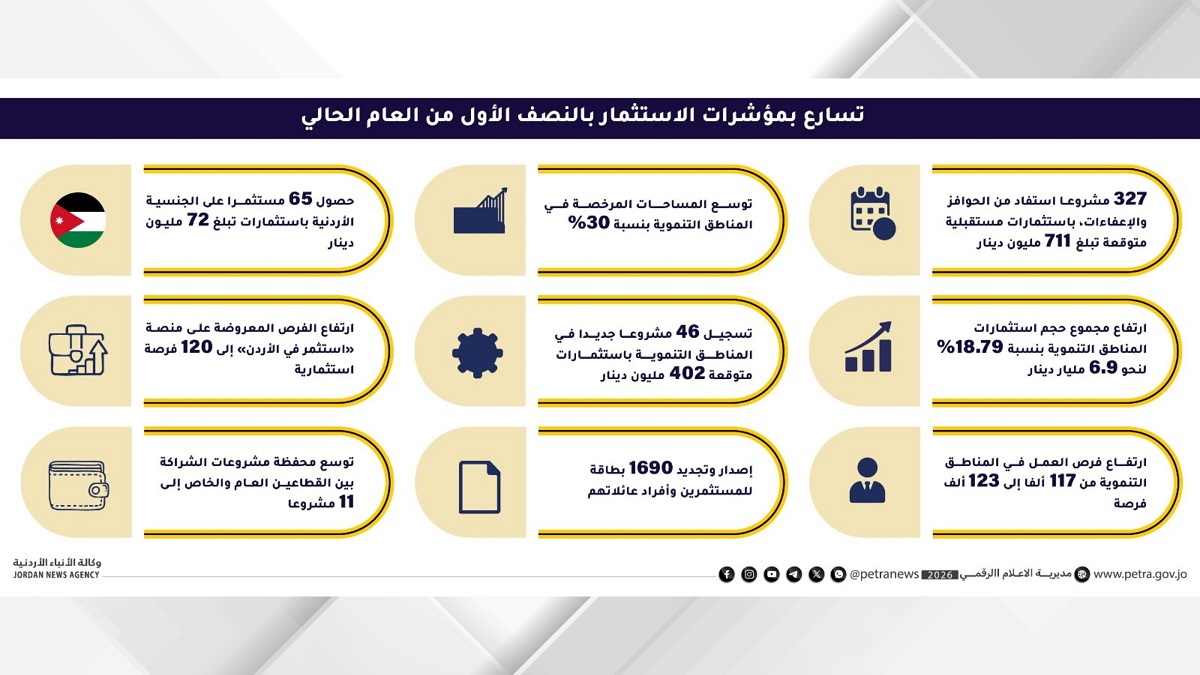
– 65 investors granted Jordanian citizenship linked to JD72.3 million
in investment
– Investment opportunities listed on Invest in Jordan platform
increase to 120
Amman, Sept. 15 (Petra) — Investment activity accelerated across
several indicators in the first half of 2026, led by an 18.79 percent
increase in development zone investments to nearly JD6.9 billion and
a sharp rise in the value of new projects entering the zones,
according to the Ministry of Investment’s semiannual performance
report.
The report showed that 327 new, expanding and developing projects
benefited from incentives and exemptions during the six-month period,
with expected future investment of approximately JD711.2 million.
That compared with 308 projects in the first half of 2025.
Investment Minister Tareq Abu Ghazaleh said the results reflect a
shift under the second phase of the Economic Modernization Vision for
2026-2029 from building regulatory and legislative frameworks toward
implementation and measurable economic impact.
He said the ministry’s approach is centered on turning investment
policies and opportunities into productive projects and supporting
investors throughout the project cycle, from establishment and
licensing to operation and expansion.
“The success of investment efforts is measured by results on the
ground and by what investments add to the national economy in terms
of production, exports and sustainable jobs,” Abu Ghazaleh said.
Investment facilitation transactions increased to 3,801 in the first
half from 2,992 a year earlier. These included new investment
decisions, exemptions, follow-up procedures and aftercare services.
The ministry also completed 3,153 follow-up transactions and issued
260 Jordanian certificates of origin.
The ministry has prepared a unified guide for incentives and
exemptions and is developing an electronic system covering exempt
fixed assets and production inputs in development zones, as part of
efforts to make procedures clearer and reduce the time and cost of
doing business.
Development zones recorded some of the strongest growth during the
period. Total investment increased from approximately JD5.819 billion
to nearly JD6.9 billion, while employment rose from around 117,000 to
almost 123,000 jobs.
Newly registered projects in the zones increased to 46 from 27 in the
first half of 2025. Their expected investment value climbed to JD402
million from around JD60 million, with the projects expected to
create 1,841 jobs once they enter implementation and operation.
The Kingdom has 20 development zones hosting 1,676 projects and
companies across industries targeted for investment, innovation and
higher-value economic activity.
Efforts to speed up construction and operation included introducing a
fast-track system for building permits and occupancy approvals. The
ministry said it became the first regulatory authority in the Kingdom
to implement the procedure.
The average time required for building permits was reduced to around
four days from seven to 15 working days, while project planning
documents can now be issued within one working day.
Licensed space inside development zones consequently rose nearly 30
percent to around 111,600 square meters, compared with 85,300 square
meters in the first half of 2025.
The ministry also issued or renewed 56 occupancy permits covering
approximately 126,000 square meters, while investor satisfaction with
development-zone developers increased to 77.1 percent from 75.1
percent.
Planning work included approval of the master plan for the third
phase of the Dhleil Development Zone, completion of studies for the
Ajloun National Park and Jerash Development Zone master plans and
updates to the King Hussein Business Park and Dead Sea Development
Zone plans.
Master plans for six industrial cities were also converted to a
geographic information system to improve planning and speed access to
information for investors.
On the regulatory front, the amended Investment Environment
Regulation No. 30 of 2026 was issued to simplify procedures, shorten
licensing and approval periods and broaden incentives to cover the
expansion and modernization of existing projects, the introduction of
new technology and support for creative industries.
The government also amended investment-based citizenship and
residency requirements to increase their economic impact and direct
more investment toward governorates and strategic national projects.
During the first half, the ministry issued or renewed 1,690 investor
cards for investors and their family members.
Six investors received five-year residency permits through real
estate investments totaling JD1.38 million. Jordanian citizenship was
granted to 65 investors, up from 29 a year earlier, with approved
applications linked to investments worth approximately JD72.3
million. Citizenship was also granted to 250 family members of
investors.
Government commissioners based at the ministry processed more than
47,000 transactions, including residency permits, visas, entry
approvals, work permits, tax procedures, Civil Defense services,
environmental and health approvals, food and drug procedures and
company registrations.
The ministry also expanded the pipeline of projects available to
prospective investors. Opportunities listed on the Invest in Jordan
platform rose from 44 in the first half of 2025 to around 120 by the
end of the first half of 2026, covering different sectors and
governorates.
Work included preparing studies and terms of reference for strategic
projects and developing a mechanism to collect, evaluate and promote
investment opportunities originating in municipalities and
governorates.
The public-private partnership portfolio expanded from eight projects
in 2025 to 11 in the first half of this year, spanning transport,
energy, water, education, health and logistics.
The ministry completed feasibility studies for three projects and
advanced technical, financial and legal preparations for others as
they move toward tendering, contracting and implementation.
Investment promotion activities were conducted in China, the United
Kingdom and several European Union countries, involving direct
meetings with companies, investors, investment funds, chambers of
commerce and financial and development institutions.
The Investment Promotion Directorate received 34 investment requests
through its investor relationship management system and helped
complete the establishment and registration of six companies with
expected investments of around $97.8 million.
Those projects are expected to create up to 2,165 jobs once
implemented and operational.
The ministry also launched an updated Arabic- and English-language
Invest in Jordan platform, integrating an interactive map of projects
and investment opportunities with information on free trade
agreements. An artificial intelligence-powered virtual assistant was
added to improve investors’ access to information.
Digital transformation efforts included redesigning investment
procedures across six directorates and service units. The ministry
reviewed 121 services and consolidated overlapping procedures,
reducing the number to 94 ahead of automation.
Electronic integration with the Income and Sales Tax Department and
Jordan Customs is also underway to facilitate data exchange and
accelerate transactions.
The ministry has developed an interactive Investment Calculator that
allows prospective investors to estimate establishment, registration,
labor, residency, energy, water, tax and operating costs based on the
type, location and size of a proposed project. The tool also provides
information on incentives and allows comparisons between locations
and investment scenarios.
The report said the investment indicators coincided with real GDP
growth of 2.9 percent in the first quarter, foreign currency reserves
exceeding $26 billion at the end of June and a 14.5 percent increase
in total exports to around JD6.4 billion.
Trading value on the Amman Stock Exchange reached around JD1.6
billion during the first half, while non-Jordanian ownership
accounted for 46.4 percent of the market capitalization of listed
shares.
The ministry said the next phase will focus on accelerating the
conversion of investment opportunities and applications into
operating projects, expanding public-private partnerships and
strengthening coordination between government agencies and the
private sector.
It said investment performance would increasingly be measured by
tangible economic outcomes, including projects entering production,
existing investments expanding, jobs being created, local suppliers
growing and governorates turning their resources and competitive
advantages into sustainable economic activity.
//Petra// RZ