Saudi Arabia’s Voluntary Carbon Market Fuels the Shift to a Low-Carbon
Under UAE President’s directives, UAE launches urgent relief response for Ghana flood victims
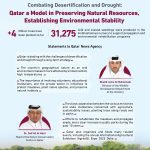
Combating Desertification and Drought: Qatar a Model in Preserving Natural Resources, Establishing Environmental Stability
UAE allocates US$30 million for emergency humanitarian response in El Obeid, calls for civilian protection, safe humanitarian aid access in Sudan


Mafraq, February 11 (Petra) — Minister of Government Communication Mohammad Momani announced the government’s decisions during its session chaired by Prime Minister Jaafar Hassan on Tuesday in Mafraq.
Momani stated that the Cabinet decided to earmark JOD500,000 from the Ministry of Finance’s 2025 allocations to begin procedures for establishing a public park in Mafraq on lands that belong to Al al-Bayt University.
He said the park would serve as a recreational space, similar to Al Hussein Parks in Amman and King Abdullah II Parks in Irbid. He praised the al-Bayt University for allocating the land for the initiative.
The allocation will allow the immediate start of the park’s construction, as pledged by the Prime Minister during a speech at the Cabinet session in Mafraq. The public park will cover an area of 200 dunums of the al-Bayt University land, featuring green spaces and various facilities for children and families.
The Council of Ministers approved the mandating reasons for the draft amended bylaw for the Groundwater Monitoring Bylaw for 2025.
Momani said the amendments include provisions on unlicensed wells in Mafraq and across the Kingdom. Under the amendments, wells currently used for agricultural purposes will be licensed according to clear guidelines, which will be announced by the Ministry of Water, and will operate under a governance framework ensuring monitoring and follow-up.
He noted that the decision will resolve and regulate many outstanding issues farmers face.
The Council of Ministers approved the decisions of the Board of Commissioners of the Energy and Minerals Regulatory Commission.
These include granting Zarqa Desert Company for Construction Materials, Quarries and Agricultural Investments the right to mine volcanic zeolite ores in the Ashqaf area of Mafraq, over 150 dunums of state-owned land, for 30 years.
Cementra Jordan Company was granted the right to mine gypsum ores in the Azraq area of Zarqa Governorate, spanning 997 dunums of state-owned land, for 8 years.
The mining rights are subject to future amendments or decisions made by the Cabinet to ensure proper implementation, rehabilitation of mining areas and fair returns to the state treasury.
Any company wishing to exercise the mining right can apply the rules to the Energy and Minerals Regulatory Commission.
Regarding health services in Mafraq, Momani said, “We have started work on maintaining the Northern Badia Hospital and a tender will be issued to establish an emergency and ambulance department along with new departments in Mafraq Governmental Hospital in 2025, for JOD8 million, in addition to other health projects.”
Momani highlighted that the government will approve providing 10 megawatts of solar energy to supply factories in the King Hussein Development Area in Mafraq with electricity. The initiative aims to support the expansion of factories and attract more investments.
He added that the government will complete the gas supply project for the development area by 2027, which will help reduce production costs for factories, increase their competitiveness and encourage further investments.
In line with efforts to modernise the political system and public sector, the Cabinet approved amendments to encourage public sector workers to participate in political life.
The changes would allow them to run for parliamentary, municipal elections and governorate councils. They would grant them an annual increase upon returning to work after elections a benefit that was not previously available.
The amendments reclassified the rank of Director General of the Prime Minister’s Office to a lower grade, now below the rank and salary of a minister.
The Cabinet approved the unification of fees imposed on Jordanian and Syrian trucks. The decision aligns with developments in transport and trade between the two countries and is based on agreements designed to facilitate goods flow and shipping at the Jaber border crossing.
The Syrian authorities had cancelled all fees and stamps at the Jaber “Nassib” crossing.
The two sides had discussed increasing trade exchange and addressing difficulties facing the private sector in both countries, focusing on facilitating transport and reducing fees imposed on transit trucks.
Momani further announced that the Cabinet approved the Pastures Strategy for the Kingdom for 2025-2030.
The strategy aims to reduce the overexploitation of pasture resources, preserve and improve vegetation cover and enhance the quality and quantity of pastureland to support livestock breeders.
It seeks to ensure the accurate and fair implementation of decisions and regulations governing the use of pastures, aiming to limit attacks on them and prevent illegal logging.
The Cabinet agreed to exempt those licensed in the public transport sector with the Land Transport Regulatory Commission from financial fines resulting from their failure to pay dues.
The decision is part of the government’s efforts to support various sectors and help mitigate financial burdens, particularly due to the economic impacts of the COVID-19 pandemic and rising fuel prices.
The Cabinet decided to grant a 25% reduction on financial dues for those who make payments before the end of the year.
To facilitate business, support investment and stimulate economic activities, the Cabinet approved the recommendations of the Committee on Pending Issues between Taxpayers and the Income and Sales Tax Department to settle 772 cases involving companies and taxpayers.
Momani pointed out that the continuation of holding monthly Cabinet sessions in different governorates is part of the government’s fieldwork approach to present its development vision to elected bodies in those areas.
Before the Cabinet session, Prime Minister Jaafar Hassan conducted an intensive tour in Mafraq, visiting several factories in the King Hussein bin Talal Development Area.
He inaugurated the new Mafraq Municipality building, which includes facilities to serve citizens and a public park. A comprehensive government services centre will be established next to it, with the municipality donating land for its construction.
Momani urged journalists to visit the development zone and explore the promising investment opportunities available, noting that the Ministry of Investment will offer opportunities, including establishing a logistics centre providing services such as clearance, handling and shipping.
Momani reviewed the most prominent development and service projects presented by the government during the Cabinet session in the presence of deputies, dignitaries, and representatives from the governorate.
He highlighted that the expansion of Mafraq Governmental Hospital, a key demand from the governorate’s residents, will include establishing a kidney dialysis unit, an emergency department and additional support departments.
A tender for the project will be issued by the end of 2025, with completion expected by 2027, for JOD8 million.
He added that financial allocations for maintaining the Northern Badia Hospital will cover the current and next two years, ensuring continued medical services.
In response to a question about Syrian refugees, Minister Momani confirmed that Jordan, under the directives of its Hashemite leadership, has received Syrian refugees since the onset of the crisis.
He said, “We are a country of chivalry, generosity and relief for the distressed, and we provide security for the fearful.”
Momani further explained that Jordan is committed to the voluntary return of Syrian refugees, with approximately 35,000 refugees having returned to Syria voluntarily.
He emphasised that the Kingdom, particularly the northern governorates, has borne a heavy burden due to the Syrian refugee crisis.
//Petra// AK
11/02/2025 19:13:49