Saudi Arabia’s Voluntary Carbon Market Fuels the Shift to a Low-Carbon

Under UAE President’s directives, UAE launches urgent relief response for Ghana flood victims
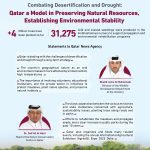
Combating Desertification and Drought: Qatar a Model in Preserving Natural Resources, Establishing Environmental Stability
UAE allocates US$30 million for emergency humanitarian response in El Obeid, calls for civilian protection, safe humanitarian aid access in Sudan


New York, Feb 18 (Petra) – Jordan on Tuesday called for an effective international effort to restart the peace process and uphold the legitimate rights of the Palestinian people, including their right to freedom, self-determination, and an independent state based on the two-state solution.
Speaking at an open UN Security Council debate on multilateralism and global governance, Jordan’s Permanent Representative to the UN, Ambassador Mahmoud Dhaifallah Hmoud, stressed the rights of Palestinian refugees to return and receive compensation under UN resolutions. He reaffirmed that the United Nations Relief and Works Agency (UNRWA) is irreplaceable and essential for providing vital services to nearly six million Palestinian refugees in the West Bank, Gaza, Jordan, Syria, and Lebanon.
“There is an urgent need for the Security Council to support UNRWA so it can fully carry out its mandate,” Hmoud said. “The agency remains the only entity capable of delivering essential services to refugees and helping Gaza’s population cope with the worsening humanitarian crisis.”
Hmoud emphasized the Security Council’s primary responsibility in maintaining international peace and security, urging unity and decisive action in addressing global crises. He called for a consensus-based approach within the Council that prioritizes conflict resolution, peacebuilding, and accountability. He also stressed the need for greater cooperation between the Security Council and the General Assembly, in line with the UN Charter, to strengthen the Assembly’s role in peace and security matters especially when the Council fails to act while urging permanent members to refrain from using veto power in ways that hinder the Council’s work.
Since its founding, the UN has played a pivotal role in preventing and managing conflicts, advancing multilateral cooperation, protecting human rights, and supporting sustainable development, Hmoud said. However, today’s evolving global landscape presents new and complex challenges that require a renewed commitment to multilateralism. He underscored the importance of strengthening partnerships among states, international organizations, civil society, and the private sector to ensure sustainable and inclusive solutions to global issues.
Referring to recent international developments, Hmoud highlighted the “Pact for the Future” adopted last September as a crucial framework for reforming and improving global governance systems. He stressed the need for substantive reforms to enhance the efficiency of multilateral institutions, particularly the UN, to address global security and development challenges effectively.
“The Security Council must take decisive action to enforce the ceasefire in Gaza under Resolution 2735, halt hostilities in the West Bank, ensure civilian protection, and guarantee sustained humanitarian aid delivery,” he said, warning of the worsening humanitarian crisis in Gaza and the occupied Palestinian territories.
On international law, Hmoud reaffirmed the importance of upholding the rule of law to ensure stability and justice at both regional and global levels. He called for full adherence to international legal norms, strengthening dispute resolution mechanisms, and respecting the role of the International Court of Justice. Upholding the principles of the UN Charter, he said, remains fundamental to protecting sovereignty, territorial integrity, and promoting peaceful conflict resolution.
Hmoud also addressed the need to bridge the development gap between developing and advanced economies, particularly in the digital sphere. He called for a comprehensive approach to international cooperation, including sustainable financial and technical support for conflict-affected countries and those hosting large refugee populations.
“This includes increased investment in digital infrastructure, expanding access to modern technologies, and building national capacities through training and knowledge transfer,” he said. “Tackling global challenges such as climate change, health crises, and food security requires adequate resources and fair financing mechanisms to enable developing nations to implement effective policies.”
“The future we share depends on our ability to work together with vision and commitment,” Hmoud concluded, emphasizing the need to revitalize multilateralism to meet the aspirations of all nations.
He underscored the potential to build a just, peaceful, and prosperous future through international cooperation, security, the rule of law, equality, human rights, and sustainable development the founding principles of the UN.
//Petra// AF
19/02/2025 00:47:57