Jordan’s Q2 2026 GDP Expands 3.0%, Outperforming Regional Headwinds, International Forecasts
ENV-KUWAIT-SUSTAINABLITYKuwait strengthens environmental sustainability through strategic initiativesBy Zahra Al-Kadhmi

HLT-KUWAIT-SURGERYKuwait advances health sector with robotic, remote surgeryBy Mohammad Al-Moseb

Saudi Arabia’s Voluntary Carbon Market Fuels the Shift to a Low-Carbon

Oman
and UNESCO: A Half‑Century of Civilisational Partnership and Renewed Commitment
Muscat,
6 Jul 2026 (ONA) — For more than five decades, the Sultanate of Oman has
cultivated a deeply rooted civilisational partnership with UNESCO, since its accession
to the Organization in 1972 — a milestone that marked a turning point in Oman’s
international presence.
Amna
Salim Al Balushi, Oman’s Permanent Delegate to UNESCO, told the Oman News
Agency (ONA) that the Permanent Delegation in Paris was established to
coordinate, communicate and document cooperation with member states, while
strengthening Oman’s participation in international committees and councils.
The
Delegation has helped consolidate Oman’s presence within UNESCO through active
engagement with other permanent delegations and representation in regional and
geographic groups, reflecting Oman’s commitment to multilateralism, she said.
The establishment of the Oman National Commission for Education, Culture and
Science in 1974 further laid a permanent framework for cooperation at the
national level.
She
added that in 1989, the late Sultan Qaboos bin Said visited UNESCO headquarters
in Paris — a landmark moment that strengthened cooperation and launched
pioneering initiatives, including the UNESCO‑Sultan Qaboos Prize for Environmental Conservation, the voyage of the Royal Yacht Fulk al‑Salamah “Ship
of Peace” to study the Silk Road, and UNESCO’s conferment of its highest medal
upon the late Sultan in 1993 in recognition of his efforts in peace and
intercultural dialogue.
The
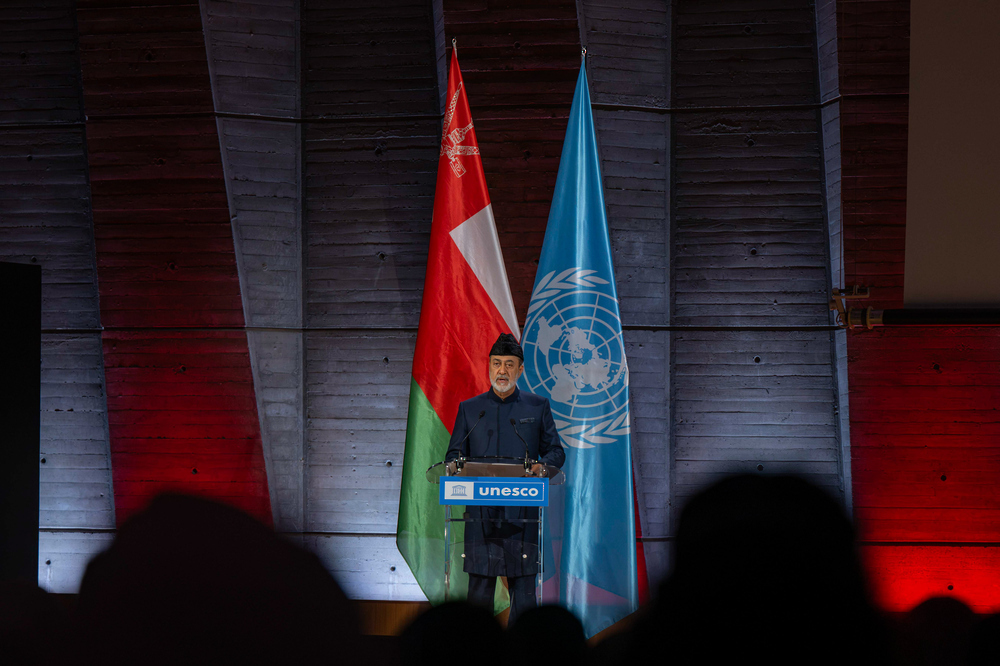
royal visit of His Majesty Sultan Haitham bin Tarik to UNESCO headquarters in
June 2026 reaffirmed Oman’s commitment to international cooperation in culture,
education and science, and its dedication to UN initiatives on heritage
preservation and intercultural dialogue, the ambassador said.
She
added that the same year saw the launch of the UNESCO‑Sultan Haitham Prize for
the Safeguarding of Intangible Cultural Heritage, underscoring His Majesty’s
role in protecting and transmitting heritage to future generations.
She
pointed out that Oman has a strong presence on UNESCO’s lists: Bahla Fort
(1987), Bat, Al‑Khutm and Al‑Ayn (1988), the Land of Frankincense (2000), the
Aflaj Irrigation System (2006) and the ancient city of Qalhat (2018) are
inscribed on the World Heritage List.
She
said that Oman’s presence on the Representative List of Intangible Cultural
Heritage has also grown, with inscriptions between 2010 and 2025 including
Al‑Bar’ah, Al‑Azi, Al‑Taghrood, Al‑Ayala, Al‑Razfa, Arabic coffee, the Majlis, Horse
and Camel Ardha “Traditional horse and camel show”, the palm tree, camel
racing, Arabic calligraphy, the Khanjar “Dagger”, Al‑Harees, henna, Al‑Bisht
and Arabic kohl. Shabab Oman vessel was also inscribed on the Register of Good
Safeguarding Practices.
Under
the Memory of the World Programme, the ambassador said that the manuscript “Ma’dan
al‑Asrar fi Ilm al‑Bihar” (A Treasury of Secrets on Ocean Navigation) was
inscribed in 2017, followed by the Al-Nuniyah Al-Kubra (The Great Nuniyah) of
navigator Ahmed bin Majid in 2025, affirming Oman’s historical contributions to
marine science and navigation. Several Omani scholars and historical figures
have also been commemorated, including Al‑Khalil bin Ahmed Al‑Farahidi, Rashid
bin Omira, Sheikh Noor al‑Din al‑Salmi, Ibn al‑Dhahabi, Abu Muslim al‑Bahlani,
Ahmed bin Majid, Humaid bin Ruzaiq, Mohammed bin Yazid al‑Azdi, Abdullah bin
Ali al‑Khalili, and Jabrin Fort as a historical event in 2023.
She
affirmed that Oman’s engagement extends to UNESCO’s programmes and networks: 44
Omani schools are part of the Associated Schools Network, and Muscat, Sur and
Nizwa were inscribed on the Global Network of Learning Cities in 2024, with
more cities under consideration. The Jabal Akhdar and Al Sireen reserves were
added to the World Network of Biosphere Reserves in 2025, reflecting Oman’s
commitment to biodiversity conservation.
She
added that Oman has ratified key UNESCO conventions, including the 1977
Convention for the Protection of Cultural Property in Armed Conflict, the 1981
World Heritage Convention, the 2005 Convention for the Safeguarding of
Intangible Cultural Heritage, the 2020 Convention on Underwater Cultural
Heritage, and acceded to the 2026 Convention against Discrimination in
Education.
She
also pointed out that Oman has served on UNESCO’s Executive Board (2023‑2027),
the Intergovernmental Committee for Intangible Cultural Heritage, the MOST
Intergovernmental Council, the International Bioethics Committee and the MAB
International Coordinating Council, reflecting international confidence in
Oman’s role in shaping UN policies and fostering cooperation.
She
further said that Omani higher education institutions host several UNESCO
Chairs covering artificial intelligence, educational psychology, ophiolite
rocks, marine biotechnology, earthquake and tsunami risk, world heritage,
aflaj, renewable energy, environmental innovation and waste‑to‑energy
conversion.
Ambassador
Al Balushi concluded that these achievements embody the depth of Oman’s
partnership with UNESCO, consolidating Oman’s position as a trusted
international partner in heritage preservation, cultural and scientific
advancement, and global efforts for sustainable development and peace.
—
Ends/Khalid