
Saudi Arabia’s Voluntary Carbon Market Fuels the Shift to a Low-Carbon

Under UAE President’s directives, UAE launches urgent relief response for Ghana flood victims

Combating Desertification and Drought: Qatar a Model in Preserving Natural Resources, Establishing Environmental Stability

UAE allocates US$30 million for emergency humanitarian response in El Obeid, calls for civilian protection, safe humanitarian aid access in Sudan

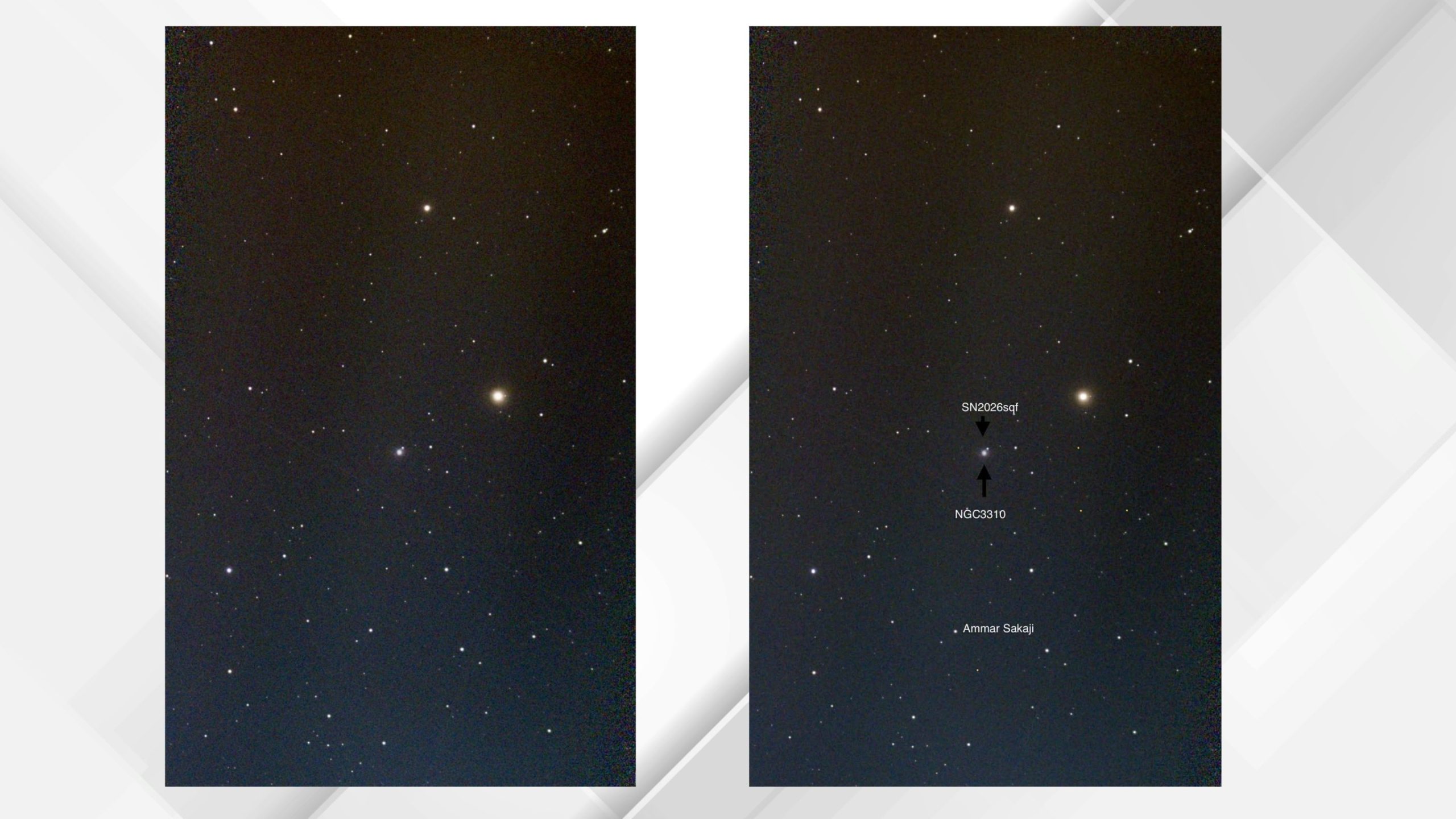
Amman, July 12 (Petra) – Supernova SN 2026sqf has been successfully
observed from Jordanian skies just three days after its global
discovery, offering astronomers and space enthusiasts a unique
opportunity to track the evolution of one of the latest stellar
explosions in the universe.
The President of the Jordanian Astronomical Society, Ammar Sakji,
stated that the supernova was discovered globally on July 8 within
the NGC 3310 galaxy, located in the Ursa Major constellation. The
cosmic event is situated approximately 50 million light-years from
Earth and currently shines at an apparent magnitude of around 13,
making it visible through telescopes and viable for astrophotography.
Sakji explained that the phenomenon is classified as a Type II
supernova, which occurs when a massive star undergoes a core collapse
after completely exhausting its nuclear fuel. He noted that the
supernova is expected to maintain its relatively high luminosity over
the coming weeks or months, providing scientists and researchers with
a valuable window to monitor its brightness curve and conduct
detailed scientific studies.
//Petra// AA