Jordan’s Q2 2026 GDP Expands 3.0%, Outperforming Regional Headwinds, International Forecasts

ENV-KUWAIT-SUSTAINABLITYKuwait strengthens environmental sustainability through strategic initiativesBy Zahra Al-Kadhmi

HLT-KUWAIT-SURGERYKuwait advances health sector with robotic, remote surgeryBy Mohammad Al-Moseb

Saudi Arabia’s Voluntary Carbon Market Fuels the Shift to a Low-Carbon

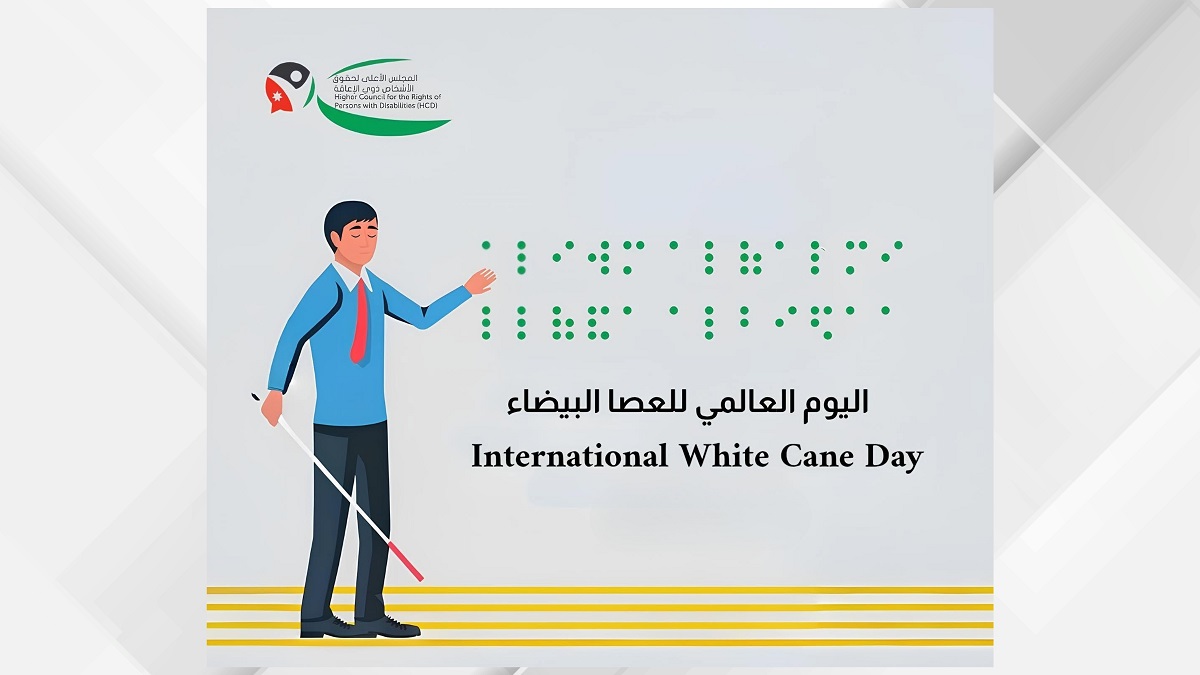
AMMAN, Oct. 14 (Petra) – For a visually impaired individual
navigating a busy urban landscape, the journey is rarely just about
getting from point A to point B. It is a daily negotiation with the
physical environment–where the choice between relying on a white
cane, leaning on a trusted companion, or navigating via mobile
applications is dictated by one crucial factor: how safe and
accessible the streets actually are.
Marked globally on October 15, White Cane Safety Day serves as a
focal point to examine the intersection of urban mobility, legal
rights, and technological innovation for Jordan’s visually impaired
community.
Rafat Al-Zitawi, spokesperson for the Higher Council for the Rights
of Persons with Disabilities (HCD), told the Jordan News Agency
(Petra) that safe and independent transit is a constitutional
entitlement and a cornerstone of human rights. “Accessible
infrastructure is the prerequisite for societal integration, enabling
individuals to access education, employment, and public services on
an equal footing,” Al-Zitawi stated.
He stressed that achieving true mobility requires a rigorous
enforcement of national building accessibility codes. Key imperatives
include laying continuous tactile paving, mounting clear directional
signage, equipping public transit fleets with real-time audio
announcement systems, and systematically retrofitting older
government facilities to bridge the gap between policy and daily
reality.
The HCD, Al-Zitawi noted, actively enforces these mandates through
on-site technical audits, engineering consultations, and direct
coordination with public sector stakeholders to ensure accessibility
is embedded into new infrastructure projects from the blueprint
phase.
Lived Realities: Autonomy, Dignity, and Environmental Barriers
For community members, mobility strategies vary based on personal
preference and urban readiness. Disability rights activist Sarah Abu
Ali opts for a human guide rather than a white cane, noting that
choices are heavily shaped by personal comfort and environmental
security.
“When public institutions integrate tactile paths, Braille signage,
and digital accessibility–complemented by staff trained to
communicate directly and respectfully–it restores a sense of dignity
and confidence,” Abu Ali explained. She emphasized that physical and
digital accessibility must work in tandem to give visually impaired
individuals the freedom to choose how they navigate public life.
Conversely, media trainer Fatima Al-Hassan relies on the white cane
as an indispensable daily tool. For her, the cane provides critical
tactile feedback about structural hazards and terrain shifts, which,
when combined with voice-guided GPS applications, enables full
spatial orientation and independent movement.
“A supportive physical environment–clear sidewalks, obstacle-free
paths, and spatial technology–transforms how we experience the city,”
Al-Hassan said, calling for broader public awareness and the direct
inclusion of visually impaired citizens in designing urban solutions.
Student Innovation: Bridging Gaps with Artificial Intelligence
While institutional frameworks advance, grassroots innovation is
stepping in to address daily operational hurdles. At the University
of Jordan, a team of five students–Hala Al-Jabour, Rawan Al-Swaiti,
Lana Azem, Amira Mehyar, and Bara’a Allan–is developing a smart white
cane prototype for the English Language Olympiad (ELO) 2026, centered
on artificial intelligence.
Informed by field observations of visually impaired peers navigating
university grounds and public transit networks, the students
identified critical pain points: imprecise navigation cues,
difficulty identifying bus routes and stop locations, hazards when
crossing roads, and the high cost or fragility of traditional canes
under extreme heat.
To address these challenges, the team is designing a collapsible,
durable cane built with heat-insulated materials and enhanced
light-reflecting elements for motorists. The device integrates GPS
tracking to prevent loss, alongside AI-driven spatial guidance that
directs users toward building entrances. Crucially, it features an
audio identification module designed to notify users of incoming
buses and upcoming stops across public transport routes, including
the Bus Rapid Transit (BRT) system.
“Our goal is to deliver an affordable, locally manufactured technical
solution that directly addresses everyday mobility hurdles,” the
student team noted, emphasizing that practical design can
significantly enhance user autonomy.
As White Cane Safety Day highlights both structural shortcomings and
emerging technological solutions, Jordan’s path toward full inclusion
relies on a dual momentum: enforcing universal design standards
across the built environment while empowering local innovation that
upholds independence and dignity for all.
//Petra// AA