Saudi Arabia’s Voluntary Carbon Market Fuels the Shift to a Low-Carbon

Under UAE President’s directives, UAE launches urgent relief response for Ghana flood victims

Combating Desertification and Drought: Qatar a Model in Preserving Natural Resources, Establishing Environmental Stability
UAE allocates US$30 million for emergency humanitarian response in El Obeid, calls for civilian protection, safe humanitarian aid access in Sudan

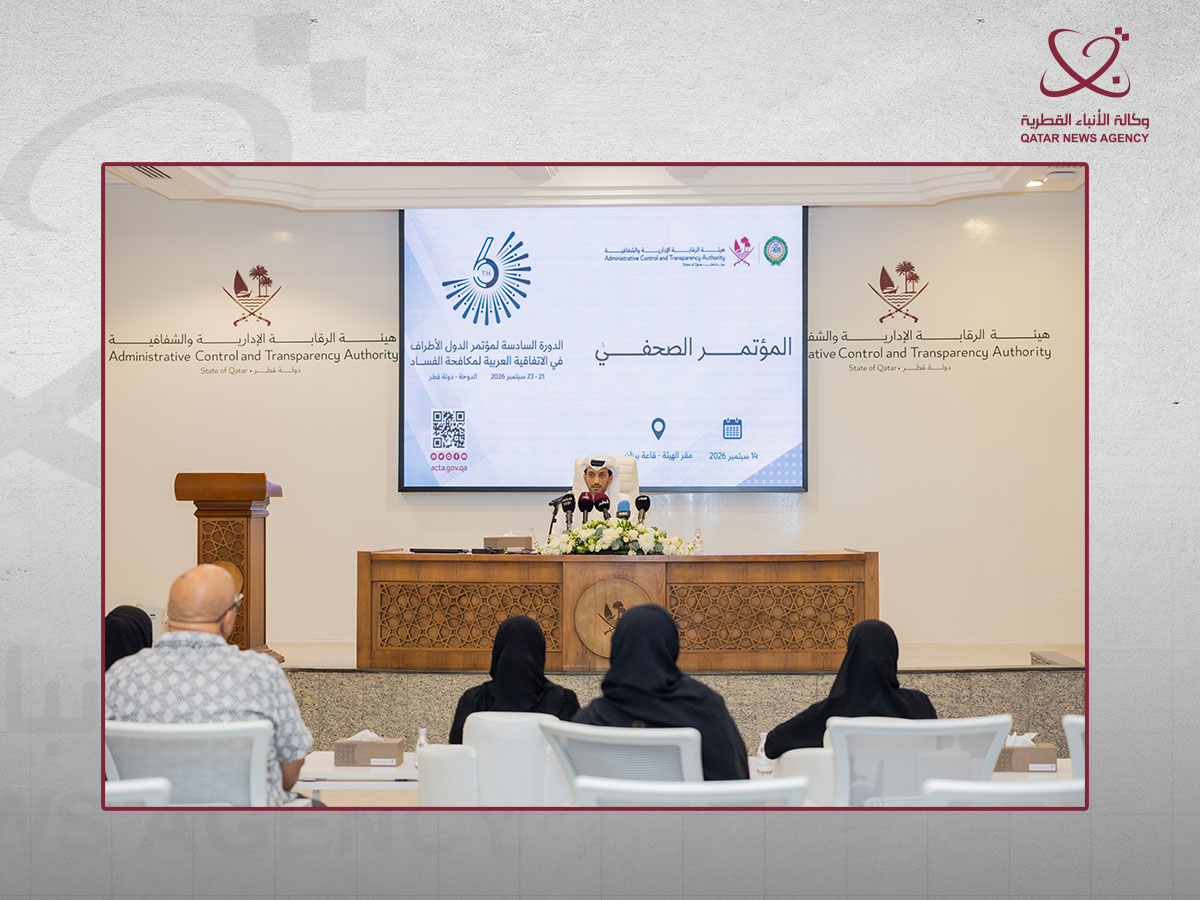
Doha, September 14 (QNA) – The Administrative Control and Transparency Authority (ACTA) Monday announced that the 6th session of the Conference of the States Parties to the Arab Anti-Corruption Convention will take place here from September 21 to 23.
The session will be chaired by HE President of ACTA, Hamad bin Nasser Al Misnad.
The announcement came during a press conference held Monday, during which ACTA spokesperson,آ Abdulwahab Al Kuwari stressed the importance of the event in strengthening joint Arab cooperation in preventing and combating corruption.
Doha’s hosting of the 6th session is an important milestone in the progress of joint Arab efforts in this regard, added Al Kuwari. It also reflects Arab states’ commitment to continuing to strengthen integrity and transparency frameworks, uphold the rule of law, and develop mechanisms for cooperation and the exchange of expertise in the field.
The ACTA spokesperson said that the event will build on the work of previous sessions, which contributed to developing the institutional and technical framework for implementing the Convention, enhancing coordination among States Parties, and discussing a number of issues related to combating corruption, including capacity-building, asset recovery, the exchange of experiences and practices, and developing mechanisms for monitoring the implementation of the Convention.
The Session’s program includes an accompanying forum addressing a number of contemporary issues related to promoting integrity and preventing corruption, Al Kuwari added, including the impact of codes of conduct on strengthening public-sector integrity, the role of artificial intelligence in supporting corruption-prevention efforts, and the role of parliamentary councils and anti-corruption bodies in supporting integrity frameworks and enhancing cooperation among them.
The ACTA spokesperson said that these issues are particularly important in light of the rapid developments taking place at the institutional, legislative and technological levels, and the need they create to develop corruption-prevention tools and enhance the effectiveness of integrity and transparency institutions.
Qatar’s hosting of the Session stems from the country’s conviction in the importance of strengthening Arab cooperation and supporting joint efforts to advance integrity and transparency practices and the exchange of expertise and experiences, he said. This serves the objectives of the Convention, enhances the effectiveness of its implementation, and strengthens its ability to address emerging challenges.
Al Kuwari hoped that the Session produces outcomes that support the progress of joint Arab efforts and assist the national efforts of States Parties, thereby achieving greater integration and coordination in preventing and combating corruption.
The ACTA spokesperson said the event is taking place at a time when there is a growing need to strengthen Arab cooperation in preventing and combating corruption, particularly amid the evolving methods used to conceal illicit proceeds, the increasing complexity of financial and legal transactions, and the rapid movement of money and information across borders.
He pointed out that what distinguishes this Session is that it builds on the achievements of the previous five sessions, with a greater focus on moving from general principles to practical implementation and measuring results.
Regarding the main issues that will be discussed, Al Kuwari said that the provisional agenda includes a number of important and interconnected topics. These include reviewing the measures taken to implement the decisions of the 5th Session and considering the recommendations issued by meetings of the subsidiary teams responsible for implementing the Convention.
The Session will also discuss developing mechanism for reviewing the implementation of the Arab Anti-Corruption Convention to monitor progress made by States Parties, identify successful practices and existing challenges, and determine technical assistance needs, the ACTA spokesperson added.
The Session’s outcomes will focus on decisions, recommendations, and a final declaration, he said. Implementation will be monitored through several means, including the Secretariat’s follow-up on adopted decisions as well as through reports on measures taken to implement decisions, with follow-up results incorporated into the agendas of subsequent meetings and sessions.
Key challenges facing Arab countries with regard to anti-corruption include disparities among countries in legislative frameworks and institutional and technical capacities, as well as the need to enhance coordination among relevant national authorities and accelerate legal cooperation procedures among states, Al Kuwari said.
The Session will seek to address these challenges by developing a mechanism for reviewing the implementation of the Convention, enhancing the exchange of expertise and successful practices, identifying countries’ training and technical assistance needs, and working to develop joint Arab tools and guides, the ACTA spokesperson added. It will also support legal cooperation and accelerate responses to requests for mutual legal assistance.
Proposed projects include holding a regional expert meeting to develop a framework for a unified Arab guide on parallel financial investigations into financial corruption crimes; a project to strengthen international cooperation by accelerating responses to requests for mutual legal assistance; and a project aimed at enhancing beneficial ownership transparency and identifying the ultimate beneficial owners. The latter could eventually pave the way for creating an Arab guide in this field.
The Session’s outcomes will be announced upon the conclusion of official deliberations and the adoption of decisions and the final statement. (QNA)