Saudi Arabia’s Voluntary Carbon Market Fuels the Shift to a Low-Carbon

Under UAE President’s directives, UAE launches urgent relief response for Ghana flood victims

Combating Desertification and Drought: Qatar a Model in Preserving Natural Resources, Establishing Environmental Stability
UAE allocates US$30 million for emergency humanitarian response in El Obeid, calls for civilian protection, safe humanitarian aid access in Sudan

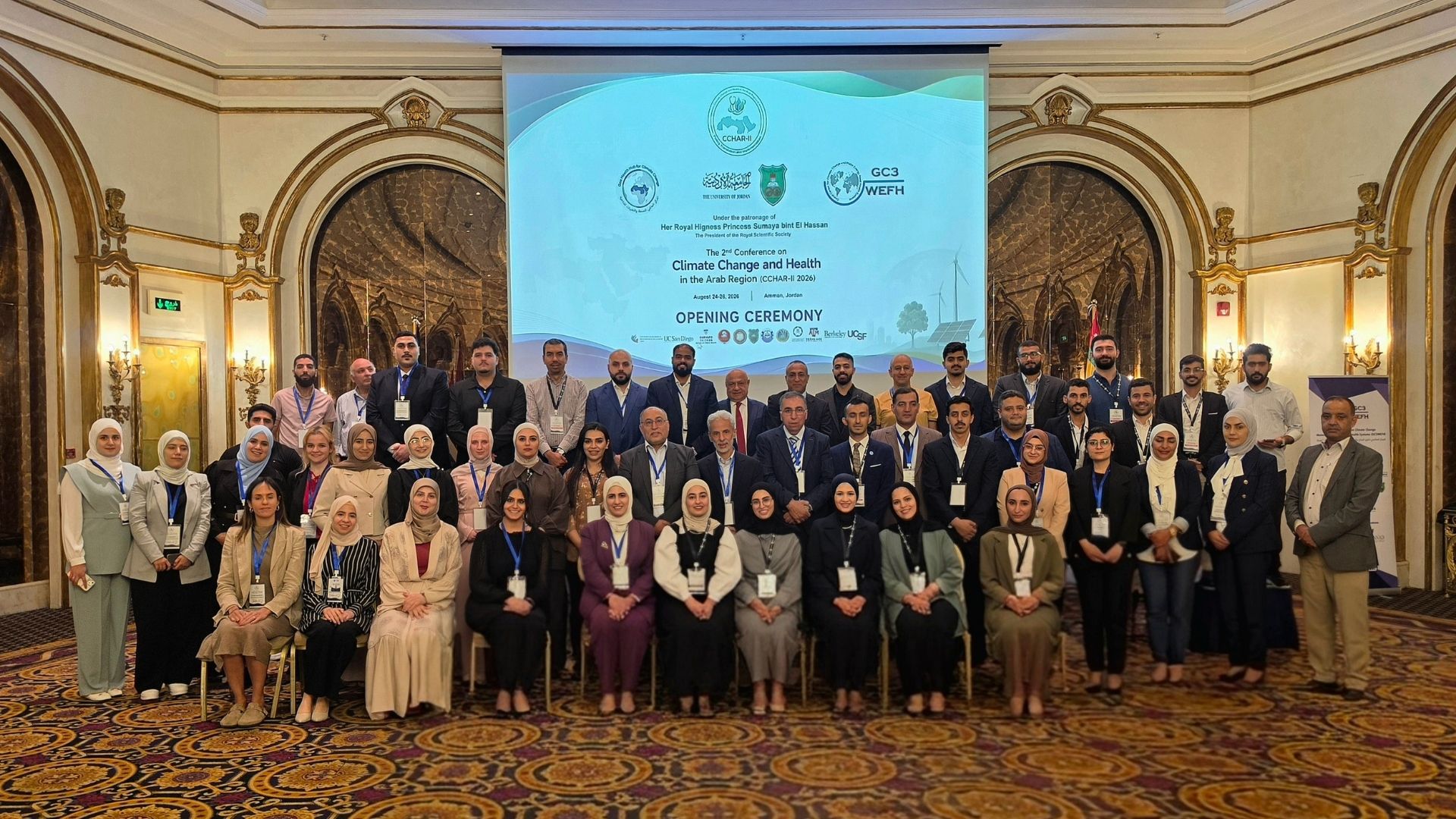
Amman, Aug. 28 (Petra)– Participants in the Climate Change and
Health in the Arab Region Conference (CCHAR-II 2026) have called for
strengthening and supporting Jordanian and Arab efforts to translate
scientific evidence and research findings into practical, actionable
policies and interventions to address the growing health impacts of
climate change and enhance communities’ capacity to adapt and build
resilience.
The participants also stressed the importance of Jordan’s role in
leading and coordinating these efforts at the regional level.
The conference, held in Amman and concluding its work on Wednesday,
brought together a group of scientists, specialists and researchers
from Arab and foreign countries. Discussions focused on the need to
move beyond knowledge and research production toward applying
scientific findings in policymaking, amid challenges including
limited local data, fragmented monitoring systems, weak intersectoral
coordination, capacity shortages, and governance, financing and
accountability challenges.
Participants emphasized that the existence of national adaptation
plans and strategies represents an important step, but stressed that
the priority should now be to accelerate implementation and link
these plans to budgets and clear, measurable performance indicators.
According to a press statement issued by the conference on Friday,
participants recommended developing sustainable and integrated
monitoring systems to track climate-related impacts across water,
diseases, healthcare, energy and food security sectors, and linking
the resulting data to policymaking.
They noted that Jordan has a model that can be built upon,
particularly given the integration of data available to researchers,
while stressing the need to strengthen the health sector’s presence
within national climate action frameworks.
The conference also called for building capacity in interdisciplinary
systems science and strengthening cooperation among different
sectors. Participants recommended making greater use of existing
scientific institutions in Jordan, including the GeoHealth Hub for
Climate Change in the Arab Region and the Global Center for Climate,
Water, Energy, Food and Health Systems at Jordanian universities, in
a move aimed at consolidating Jordan’s position as a regional hub for
knowledge and expertise exchange.
The recommendations further stressed the importance of adopting
evidence-based budgeting and linking policies to specific, measurable
health outcomes.
Participants said that focusing on tangible health outcomes such as
the relationship between rising temperatures and rainfall patterns
and certain diseases, or between dust storms and increased asthma
cases could be more effective in supporting decision-making than
addressing climate change in broad terms.
They called for developing local evidence demonstrating these links
and helping direct resources toward the interventions with the
greatest impact.
The conference also emphasized the importance of accountability and
key performance indicators, linking them to government budgets and
programs. Participants suggested that Jordan’s Economic Modernization
Vision could be leveraged to develop indicators measuring outcomes
and impact.
They also called for periodic reports on the implementation of
climate and health plans to be submitted to oversight and legislative
bodies.
Participants recommended making greater use of water-quality data as
an important indicator of climate-related changes and called for
making data on nitrates, pollutants and other indicators available to
researchers and relevant institutions to support disease forecasting
and the development of early warning systems.
Dr. Ahmad Al-Salaymeh, chairman of the conference’s organizing
committee, said successful interventions require multisectoral
partnerships and the involvement of stakeholders, as well as drawing
on successful regional experiences.
He also stressed the importance of strengthening political and
scientific dialogue to help build consensus around policies, noting
that working within separate institutional “silos” limits the
effectiveness of responses to the health impacts of climate change.
The recommendations stressed the need for sustainable national
funding for climate and health initiatives rather than relying solely
on external financing. They also called for empowering environmental
health directorates and departments within health ministries,
particularly in Jordan, to take a proactive approach, develop clear
performance indicators and strengthen their role in planning for and
responding to climate and health risks.
The conference further highlighted the importance of knowledge
transfer and the exchange of successful experiences among Arab
countries, as well as documenting policies and implementation tools
that can be adapted and applied by participating countries.
In the energy sector, participants recommended exploring and
developing decentralized solar energy systems coupled with storage
technologies, given their potential to support the energy transition,
reduce air pollution and improve health outcomes.
Dr. Wael Al-Dulaimi, a professor of public health at the University
of California San Diego and director of projects funded by the US
National Institutes of Health for the conference, said Jordan has the
scientific and institutional capabilities needed to strengthen its
regional role in climate and health.
He called for building on these capabilities and expanding
partnerships among the government, universities, research centers,
private sector and civil society to establish an approach that links
science to policy, financing to implementation, budgets to outcomes,
and accountability to impact.
//Petra// MF