Saudi Arabia’s Voluntary Carbon Market Fuels the Shift to a Low-Carbon

Under UAE President’s directives, UAE launches urgent relief response for Ghana flood victims

Combating Desertification and Drought: Qatar a Model in Preserving Natural Resources, Establishing Environmental Stability

UAE allocates US$30 million for emergency humanitarian response in El Obeid, calls for civilian protection, safe humanitarian aid access in Sudan

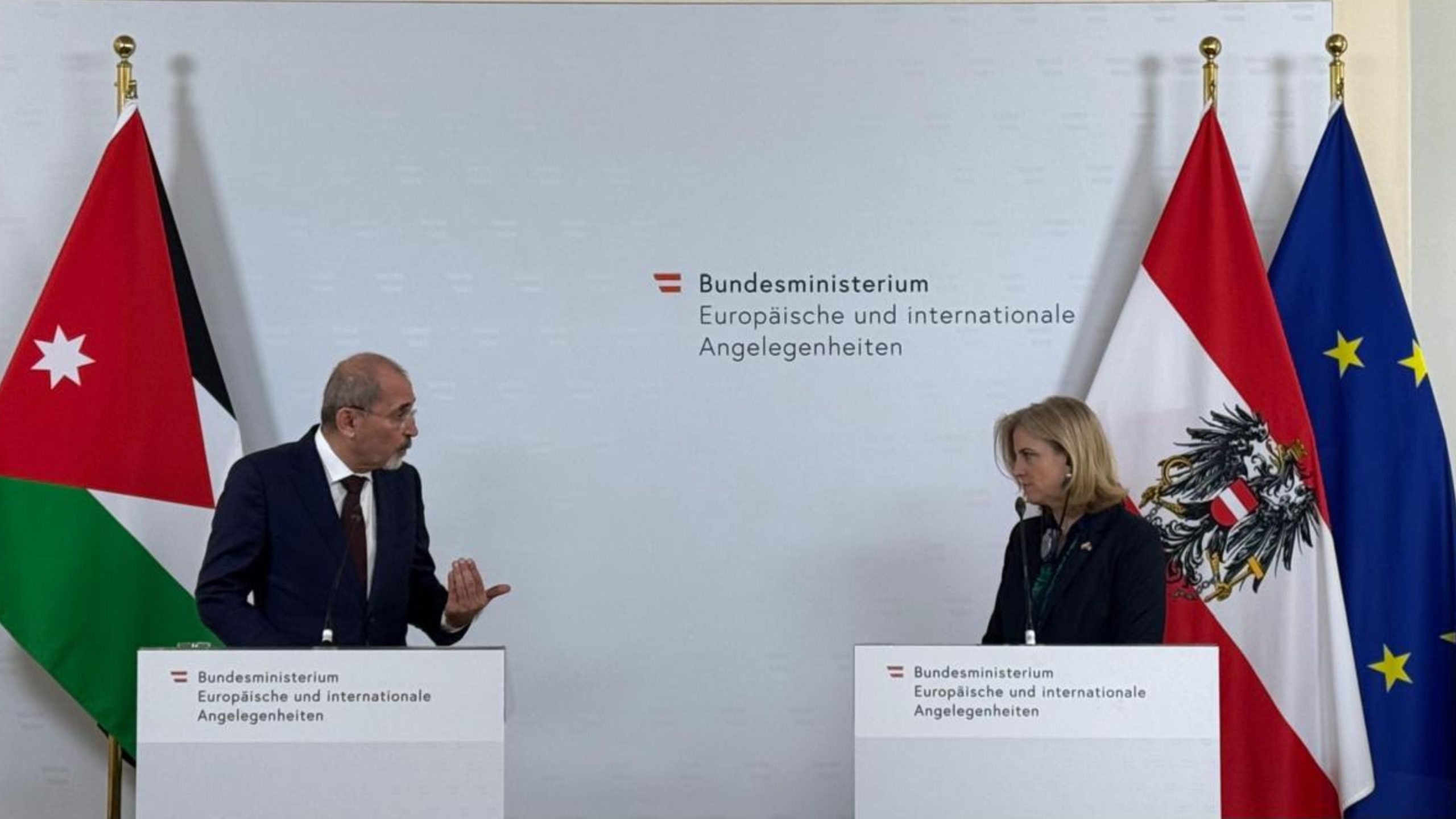
Vienna, Sept. 3 (Petra)– Deputy Prime Minister and Minsiter of
Foreign and Expatriates Affairs Ayman Safadi and Austrian Federal
Minister for European and International Affairs Beate Meinl-Reisinger
on Thursday affirmed their countries’ commitment to further
developing comprehensive cooperation in the service of their shared
interests and strengthening the partnership that has linked Jordan
and Austria for more than 70 years of diplomatic relations.
During talks in Vienna, the two ministers discussed practical steps
to enhance cooperation in the economic, trade, investment, tourism,
education and defense sectors.
They also addressed regional developments and efforts aimed at ending
the escalation in the region and promoting security and stability.
At a press conference following the talks, Safadi stressed Jordan’s
importance attached to its partnership with Austria, highlighting
opportunities to expand cooperation across various fields.
He said Jordanian-Austrian relations are clearly moving forward, as
reflected in joint economic, educational and defense cooperation
programs, as well as bilateral and European Union-backed efforts to
promote regional stability.
Safadi also underscored the importance of resuming direct flights
between Amman and Vienna in boosting tourism and trade exchanges
between the two countries.
He commended Austria’s support for the two-state solution and its
assistance in humanitarian response efforts in Gaza and in meeting
the needs of refugees.
Safadi said he discussed the situation in Gaza with his Austrian
counterpart, stressing the need for the full implementation of US
President Donald Trump’s plan to stabilize the enclave and for the
complete removal of Israeli restrictions on the entry of humanitarian
aid.
He warned of the consequences of Israel’s unlawful measures in the
occupied West Bank, including settler violence, settlement expansion,
land confiscation and violations of the historical and legal status
quo at Islamic and Christian holy sites in Jerusalem.
Such measures, he said, undermine the two-state solution and all
prospects for achieving a just and comprehensive peace.
Safadi stressed the need for the international community to take
effective and influential measures to halt these actions and protect
the right of all peoples in the region to live in security and peace.
He said he also discussed with Meinl-Reisinger support for the Syrian
government in its reconstruction efforts, describing Syria as a
“success story” that Jordan and Austria agree should be supported.
Safadi stressed the need to support the Lebanese government in
extending its sovereignty over all Lebanese territory, secure
Israel’s withdrawal from Lebanese territory it occupies, implement
understandings reached with the Lebanese government and uphold UN
Security Council Resolution 1701.
He also condemned Iranian attacks against Jordan and the Gulf
Cooperation Council countries, noting that the attacks began hours
after the outbreak of the latest war, despite Jordan and other Arab
countries not being parties to the conflict and having worked to
prevent it from erupting.
Safadi said Jordan and Austria share the view that diplomacy and
dialogue should be the means of resolving the crisis.
Responding to a question, Safadi said the United States is a partner
of Jordan and that the two countries cooperate under a defense
cooperation agreement. The presence of US forces in Jordan, he
explained, is governed by the agreement, with the forces stationed at
Jordanian military bases and cooperating with the Jordan Armed Forces
in several areas.
He noted that Jordan has similar defense cooperation arrangements
with other partner countries whose forces are present in the Kingdom,
including Austria. The two countries signed a defense cooperation
agreement in April 2026 that provides a framework for the presence of
Austrian forces in Jordan to participate in military training and the
exchange of expertise.
Safadi said Jordan’s defense cooperation with partner countries has
continued for years and has played an effective role in
counterterrorism efforts.
He stressed that Jordan seeks good relations with Iran, but achieving
such relations requires addressing all previous sources of tension,
including support for drug and arms smuggling into Jordan and
attempts to undermine the Kingdom’s security and stability.
Safadi reaffirmed that Jordan will continue to exercise its sovereign
and legal right to take all necessary measures to protect its
security, stability, sovereignty and the safety of its citizens.
He also congratulated Meinl-Reisinger on Austria’s election as a
member of the UN Security Council for a term beginning early next
year.
For her part, Meinl-Reisinger said Austria considers Jordan a key
partner in the region and a pillar of regional security and
stability, highly commending the Kingdom’s role in efforts to promote
security, stability and peace in the region.
She also highlighted the depth of the longstanding friendship between
Austria and Jordan, which has included numerous royal visits to
Austria, stressing the importance of building on the bilateral
cooperation achieved, particularly in tourism and renewable energy.
Meinl-Reisinger also emphasized the importance of continuing defense
and security cooperation between the two countries under the defense
cooperation agreement signed in April 2026, which enables joint
cooperation programs and military exercises.
She condemned the Iranian attacks against Jordan and expressed
Austria’s solidarity with the Kingdom in confronting them.
Meinl-Reisinger also praised Jordan’s role in delivering humanitarian
assistance to Gaza and providing medical treatment to injured
children from the Gaza Strip in Jordanian hospitals.
She commended Jordan’s efforts to support Syria’s stability, assist
its recovery and encourage the voluntary return of Syrian refugees.
Earlier on Thursday, Safadi met with several members of the Foreign
Affairs and Defense Committees of the Austrian Parliament.
The discussions covered Jordanian-Austrian relations and ways to
strengthen them, regional and international developments, and
prospects for enhancing parliamentary cooperation between the two
countries, particularly in light of an upcoming visit to Jordan by
the Austrian Parliament’s cross-party Middle East/Gulf Parliamentary
Friendship Group.
Safadi also met with International Atomic Energy Agency Director
General Rafael Grossi to discuss ways of strengthening cooperation
between Jordan and the agency.
On Wednesday, Safadi participated in a dialogue session titled
“Jordan’s Role in the Middle East: Peacemaker, Mediator and Pillar of
Stability” at the Bruno Kreisky Forum for International Dialogue in
Vienna.
//Petra// MF