Saudi Arabia’s Voluntary Carbon Market Fuels the Shift to a Low-Carbon

Under UAE President’s directives, UAE launches urgent relief response for Ghana flood victims

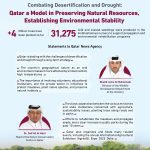
Combating Desertification and Drought: Qatar a Model in Preserving Natural Resources, Establishing Environmental Stability
UAE allocates US$30 million for emergency humanitarian response in El Obeid, calls for civilian protection, safe humanitarian aid access in Sudan

AMMAN, Sept. 5 (Petra) — Firmly anchored by macroeconomic stability,
a resilient monetary framework, and robust infrastructure, Jordan
stands out as a premier investment destination in the region,
offering a reliable springboard for sustainable economic growth and
global competitiveness.
Attracting capital to the Kingdom is no longer merely a theoretical
target outlined in national modernization roadmaps; it is an
operational reality backed by a thriving ecosystem of international
corporations and industrial leaders that have chosen Jordan as their
operational home.
Today, the Kingdom presents an economic model that bridges secure
business conditions with continuity during regional turbulence. Core
advantages–ranging from a stable currency peg and advanced digital
infrastructure to mature industrial zones–demonstrate to
international investors that Jordan offers an ideal foundation for
long-term venture success.
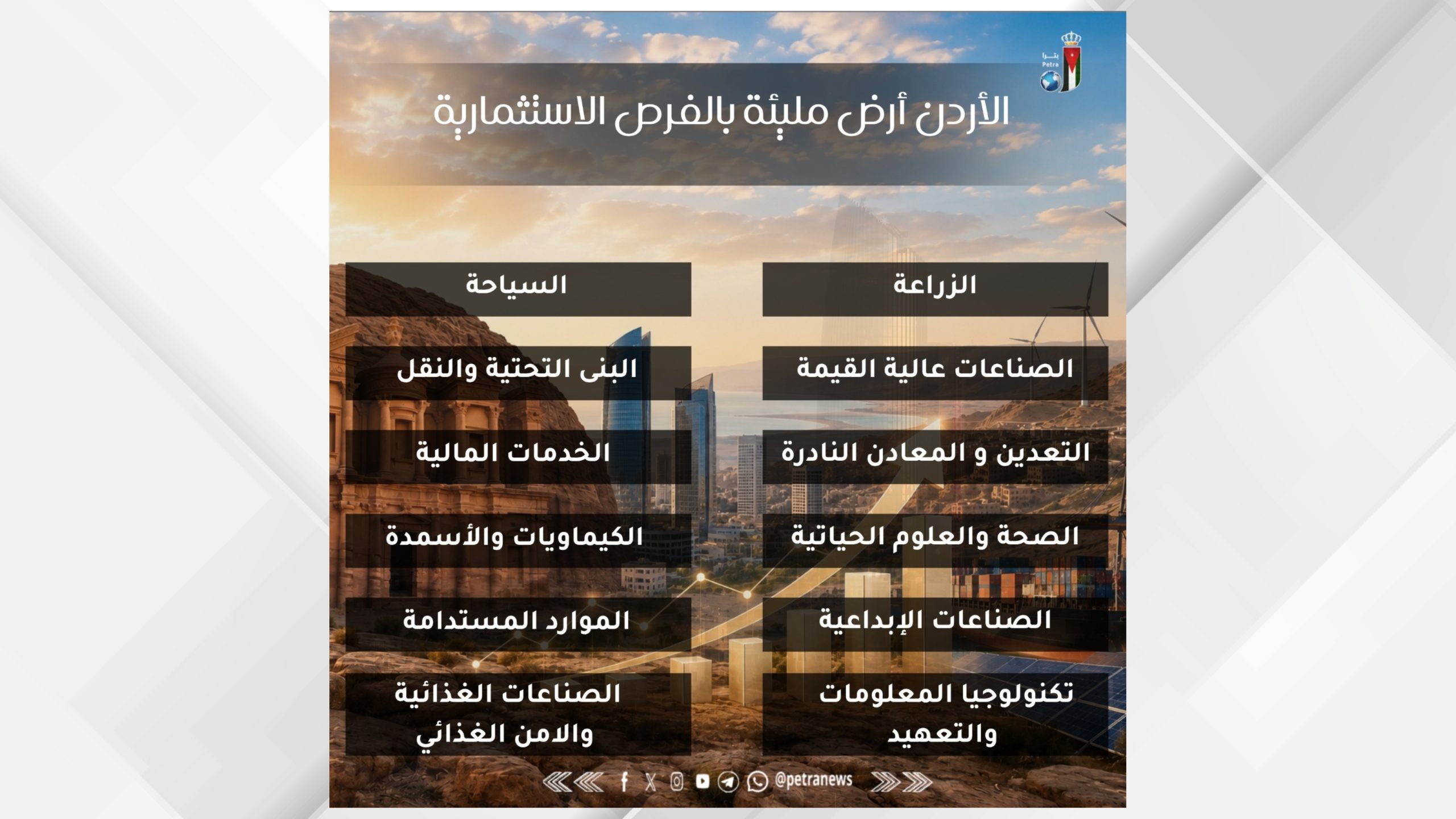
Lucrative investment opportunities span a diverse array of high-value
sectors, including advanced manufacturing, rare earth minerals and
mining, IT outsourcing, healthcare, life sciences, food processing,
creative industries, transport infrastructure, renewable energy,
water resources, tourism, financial services, and chemical
fertilizers.
Local business leaders and investors interviewed by the Jordan News
Agency (Petra) emphasized that Jordan’s allure extends far beyond
basic regulatory incentives. The Kingdom provides a secure
environment that safeguards business continuity, reinforced by direct
access to global markets via comprehensive trade agreements and a
highly skilled, locally trained workforce.
Moath Al-Saaideh, Executive Director at Pine Tree Garments–a
Singaporean investment operating in the Kingdom since 2014–stated
that one of Jordan’s greatest competitive edges is the diplomatic
stability championed by His Majesty King Abdullah II. This leadership
has fostered balanced international relations and a robust network of
trade agreements, granting Jordanian goods preferential market access
worldwide.
Al-Saaideh noted that Jordan has repeatedly demonstrated an
exceptional ability to maintain social and economic continuity
despite regional headwinds, shielding supply chains, energy flows,
and commercial traffic from abrupt disruptions. He added that the
Kingdom features advanced compliance frameworks mirroring those of
major industrial economies, covering labor rights, social security,
occupational safety, and environmental governance.
“International brands no longer look solely at production costs; they
evaluate the entire supply chain and its alignment with
environmental, social, and governance standards,” Al-Saaideh said,
pointing out that Jordan’s early strides in circular economy
initiatives and clean energy are rapidly becoming key
differentiators.
Haitham Al-Rawajbeh, CEO of Falcon Software, highlighted that the
country’s technological edge is anchored by political stability,
human capital, and a progressive legal framework that enables
long-term digital planning. He pointed to high-growth areas such as
software engineering, artificial intelligence, cybersecurity, cloud
computing, and exportable digital services as prime avenues for
high-value expansion.
“Jordanian technology firms have proven their capacity to scale
regionally, solidifying the Kingdom’s position as a central digital
hub for the Middle East,” Al-Rawajbeh noted.
Abdulrahman Abu Teir, founder of Smart Millennium Ltd. and the
Jordanian-British Smart Energy Solutions Company, stressed that
financial stability, security, and human talent make Jordan an
optimal launchpad for knowledge-based industries and smart energy
systems.
“Investors seeking long-term predictability find foundational
confidence here, supported by an educational pipeline capable of
supplying top-tier engineering talent,” Abu Teir said.
Meanwhile, Ehab Qadri, Managing Partner at Al-Karam Qadry Group,
noted that investors enter a mature industrial ecosystem built over
decades rather than starting from scratch. He cited comprehensive tax
exemptions, competitive customs incentives on fixed assets, and
integrated industrial cities distributed across governorates as key
pillars supporting manufacturing and export-oriented ventures.
Rami Al-Saheb, founder and chairman of Al-Hadaf (RZ) Group and
Bashtawi & Sahib Group, concluded that Jordan’s ongoing regulatory
reforms–highlighted by the Investment Environment Law, streamlined
licensing procedures, and compliance-based frameworks within
development zones–continue to actively elevate the investor
experience.
//Petra// AA