Saudi Arabia’s Voluntary Carbon Market Fuels the Shift to a Low-Carbon

Under UAE President’s directives, UAE launches urgent relief response for Ghana flood victims
Combating Desertification and Drought: Qatar a Model in Preserving Natural Resources, Establishing Environmental Stability
UAE allocates US$30 million for emergency humanitarian response in El Obeid, calls for civilian protection, safe humanitarian aid access in Sudan

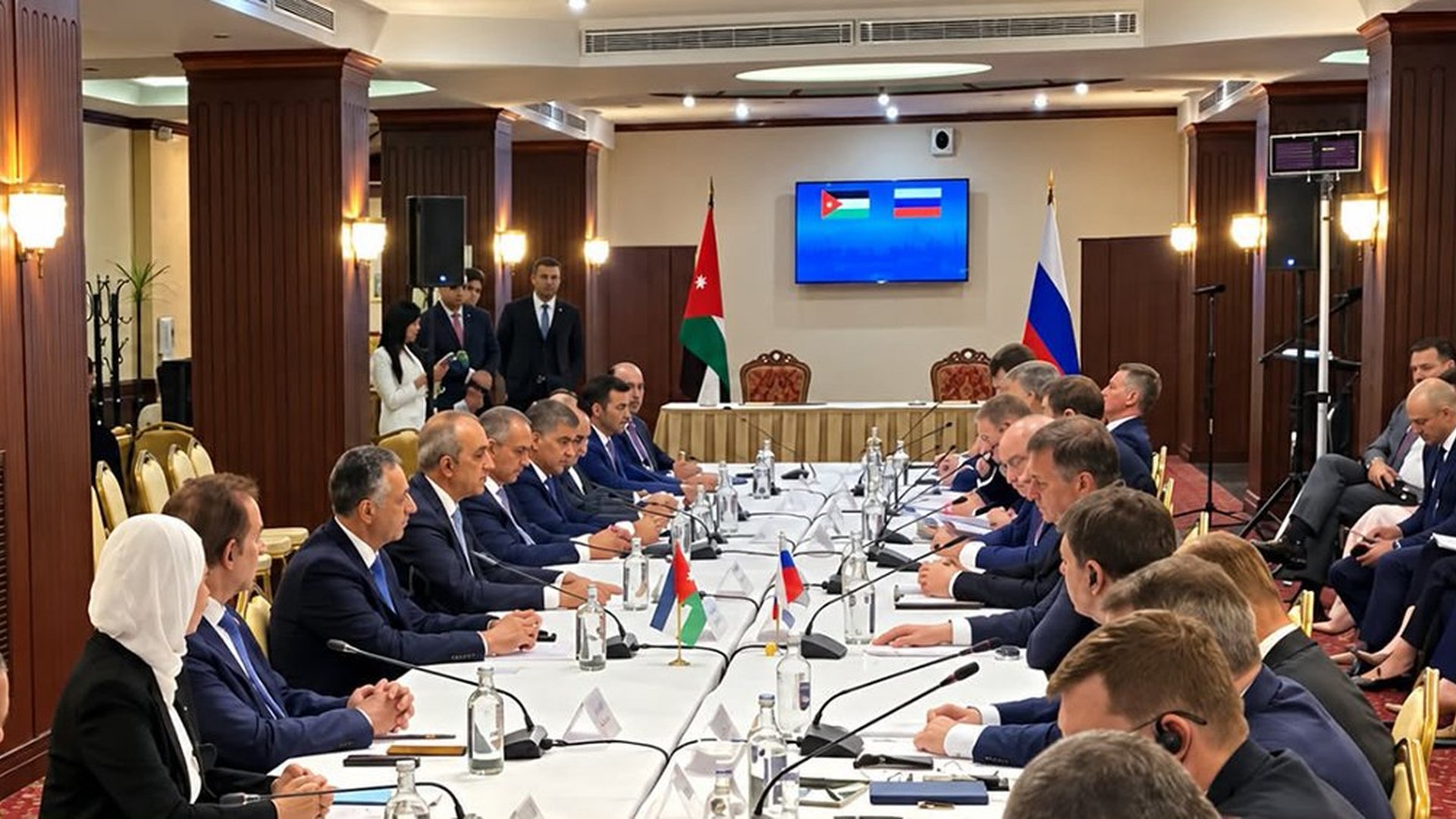
MOSCOW, Sept. 12 (Petra) – Jordan and the Russian Federation have
agreed on a series of practical measures to deepen bilateral
economic, trade, and investment ties, boost inter-state commerce, and
expand collaboration across key strategic sectors.
The agreements came at the conclusion of the seventh session of the
Jordanian-Russian Intergovernmental Joint Committee for Economic,
Trade, Scientific, and Technical Cooperation.
Hosted in Moscow from September 8 to 11, the high-level meetings were
co-chaired by Jordan’s Minister of Industry, Trade and Supply, Eng.
Yarub Qudah, and Russian Deputy Prime Minister Dmitry Patrushev.
The sessions drew senior government officials and institutional
representatives from both nations, including Jordanian Minister of
Agriculture Saeb Khraisat, Minister of Tourism and Antiquities Imad
Hijazeen, and Jordanian Ambassador to Russia Khalid Al-Shawabkeh,
alongside Russian Ambassador to Jordan Gleb F. Desyatnikov.
Opening the proceedings, Qudah underscored the imperative of
diversifying the mutual exchange of goods and services, maximizing
Jordanian corporate participation in Russian trade exhibitions, and
mobilizing private-sector stakeholders to capitalize on untapped
bilateral investment prospects.
He pointed to lucrative partnership opportunities in pharmaceuticals,
transport infrastructure, and joint manufacturing, noting that
Russian enterprises could leverage Jordan’s robust network of free
trade agreements with global economic blocs.
Qudah further highlighted regional commercial horizons, framing
Jordan as a strategic logistics hub and operational base for Russian
firms looking to engage in impending post-war reconstruction projects
in neighboring Syria and Iraq. He also updated delegates on advanced
negotiations regarding preferential trade agreements with Rwanda and
Uzbekistan, designed to pave new inroads for Jordanian exports into
African and Central Asian markets.
Reaffirming the importance of institutional continuity, Qudah called
for regular committee cycles, announcing that Amman will host the
eighth session in 2027.
For his part, Patrushev stressed the unique character of
Jordanian-Russian relations, designating the joint committee as a
vital engine for boosting bilateral trade volume. He reiterated
Moscow’s readiness to scale up strategic cooperation and execute
mutual-benefit projects spanning trade, industry, investment, energy,
agriculture, food security, transport, logistics, tourism, and
information and communications technology (ICT).
Ahead of the ministerial plenary, the joint preparatory technical
committee met under the co-chairership of Jordanian Ministry of
Industry, Trade and Supply Secretary-General Dana Al-Zoubi and
Russian Deputy Minister of Economic Development Vladimir Ilichev.
Al-Zoubi asserted that current bilateral trade volumes still fall
short of actual potential, demanding targeted mechanisms to dismantle
trade barriers and accelerate commercial exchange.
On the sidelines of the summit, the Jordanian delegation engaged with
representatives of the Eurasian Economic Union (EAEU) to evaluate
pathways for expanded trade, review ongoing free trade agreement
negotiations, and establish a dedicated joint committee on trade and
investment. Both sides agreed to intensify data-sharing and
regulatory coordination to enhance market access for Jordanian goods
within the EAEU bloc.
Concluding the summit, Qudah and Patrushev signed the official
protocol of the seventh joint committee session. Additional pacts
signed included a protocol between the Federal Customs Service of the
Russian Federation and the Jordan Customs Department concerning the
exchange of customs valuation data, alongside a memorandum of
understanding on healthcare cooperation.
Both capitals committed to rigorous follow-up mechanisms to translate
the summit’s outcomes into concrete commercial programs and joint
ventures.
//Petra// AA