ENV-KUWAIT-SUSTAINABLITYKuwait strengthens environmental sustainability through strategic initiativesBy Zahra Al-Kadhmi

HLT-KUWAIT-SURGERYKuwait advances health sector with robotic, remote surgeryBy Mohammad Al-Moseb

Saudi Arabia’s Voluntary Carbon Market Fuels the Shift to a Low-Carbon

Under UAE President’s directives, UAE launches urgent relief response for Ghana flood victims

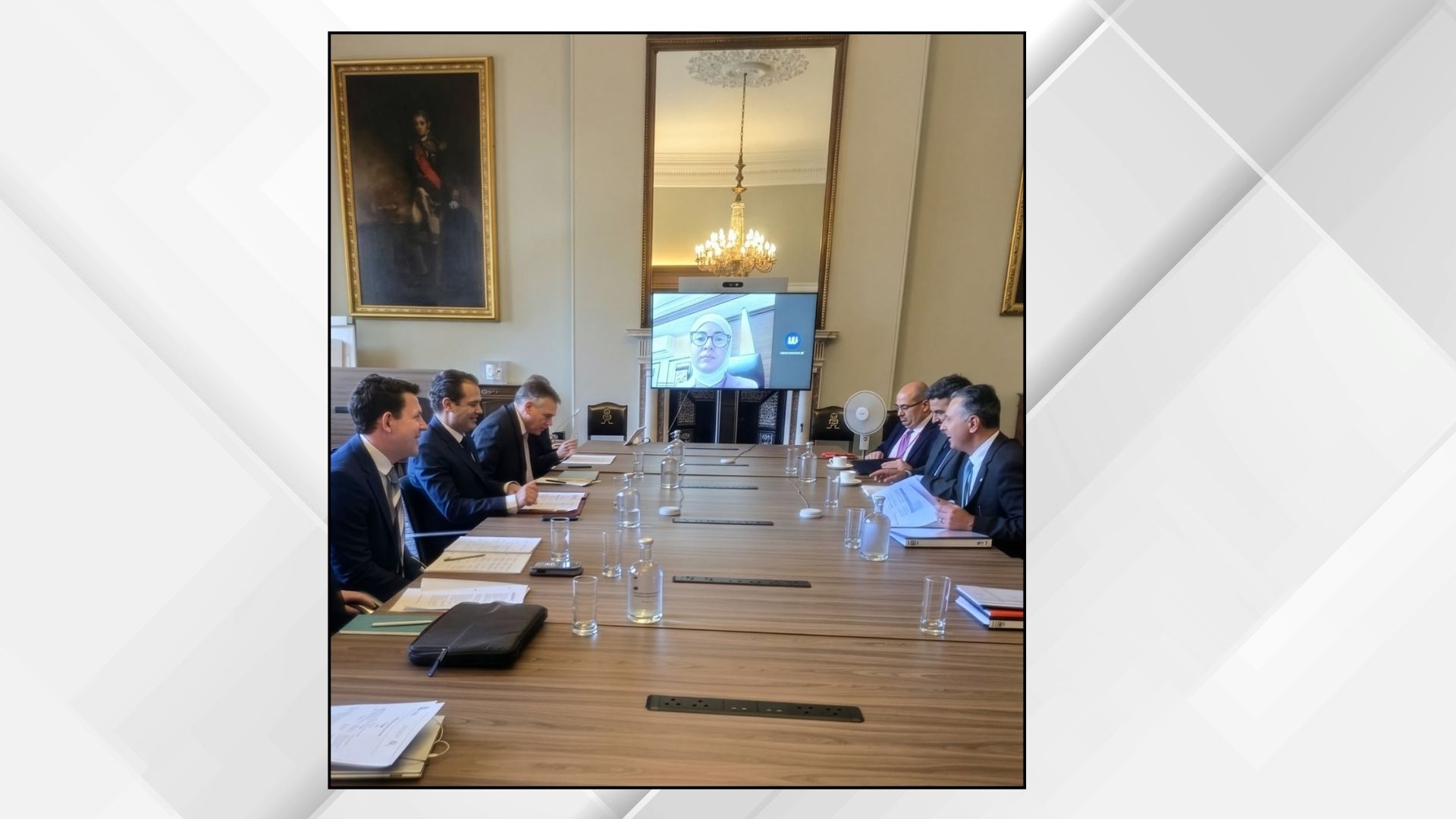
Amman, July 7 (Petra) — Minister of Industry, Trade and Supply
Yarub Qudah and UK Parliamentary Under-Secretary of State for the
Middle East Hamish Falconer co-chaired the second Jordan-UK
Partnership Council in London.
The two sides reviewed progress in implementing the bilateral
partnership agreement and discussing ways to expand economic, trade
and investment cooperation.
According to a ministry statement issued Tuesday, the meeting, held
at the UK Foreign, Commonwealth and Development Office, reaffirmed
the “deep strategic and historic” ties between Jordan and the United
Kingdom, noting bilateral relations have entered their second
century as a “model of sustainable” economic cooperation.
The council reviewed bilateral trade indicators, which showed
Jordanian exports to the UK rising 88% during the first four months
of this year to $37.2 million, up from $19.8 million in the same
period last year.
Jordan’s imports from the UK fell 17 percent to $115.2 million,
reducing the trade deficit to $78.1 million.
Talking at the discussions, Qudah said the meeting’s outcomes
reflected the “strength” of the economic partnership and both
countries’ commitment to advancing it in line with evolving economic
conditions and shared interests.
He said Jordan remains committed to implementing the Economic
Modernization Vision and maintaining a “competitive” investment
environment, adding that Jordan’s proposals to streamline rules of
origin are intended to expand capacity of national industries to
benefit from preferential trade arrangements, increase exports,
create jobs and attract high-value investment.
Qudah said Jordan is “well positioned to serve as a regional hub” for
industry, logistics and reconstruction, citing the Kingdom’s
stability, advanced infrastructure and investment incentives, and
invited British companies to capitalize on investment opportunities
across multiple sectors.
He also called for reaching a bilateral agreement to extend the
existing rules of origin simplification decision under the
partnership agreement for an additional 15 years beyond 2030.
Jordan proposed expanding the arrangement to cover all products
manufactured in the Kingdom without requiring employment of Syrian
workers within production facilities, following Jordan’s issuance of
more than 60,000 valid work permits for Syrian nationals.
The proposal also calls for extending coverage to processed
agricultural and food products. The two sides agreed to establish a
joint technical committee to develop practical solutions on
simplifying rules of origin within three months.
The council approved recommendations to restructure the agreement’s
governance framework by replacing its four subcommittees with a new
structure comprising the ministerial-level Partnership Council and a
unified Partnership Committee to oversee technical matters and
accelerate implementation.
Qudah also welcomed UK support for the Trade in Services Development
Project, funded through the UK Trade Partnerships Programme in
cooperation with the International Trade Centre, which aims to
develop studies and a roadmap for advancing Jordan’s services sector
and its regulatory framework. He underscored the importance of
expanding future cooperation, particularly in engineering and
education services.
The Jordanian delegation outlined key initiatives under the Economic
Modernization Vision, including the industrial policy aimed at
strengthening “competitiveness of high-value” sectors, reducing
production costs, promoting innovation and supporting the transition
to a green economy.
The delegation also highlighted the National Export Strategy, which
has enhanced export competitiveness and diversified export products,
as well as the role of the Industry Support Fund in boosting
productivity and creating jobs.
Both sides also praised the successful exports of phosphate and
potash products to the UK market, which are a “model” that could
encourage more Jordanian companies to enter the British market and
build private-sector partnerships.
For his part, Falconer reaffirmed the United Kingdom’s commitment to
strengthening its economic partnership with Jordan and building on
progress achieved under the bilateral partnership agreement.
He said the UK views Jordan as a “trusted” partner with a strategic
location and a promising business environment, expressing Britain’s
interest in expanding cooperation in trade, investment and services
to support economic growth and create new opportunities for the
private sector in both countries.
Falconer added that the UK would continue supporting initiatives that
promote trade development, knowledge exchange and institutional
cooperation in ways that advance shared interests and deepen
bilateral economic relations.
The Jordanian delegation also presented the Kingdom’s advantages as a
regional logistics hub for reconstruction efforts, highlighting plans
for a 900-dunum special free zone in Mafraq Governorate and the
Mafraq Dry Port project, which are expected to provide British
companies with investment opportunities in construction and
engineering services supported by customs and tax incentives.
The two sides also agreed to address obstacles affecting trade to
ensure the continued smooth flow of commerce.
The meeting further discussed economic and industrial priorities,
emphasizing the importance of activating the Joint Jordanian-British
Business Council, strengthening private-sector engagement, increasing
reciprocal trade missions and encouraging British companies to
participate in the Jordanian-British Business Forum scheduled to be
held in London later this month.
Both sides agreed to continue working beyond the Partnership Council
meeting and the business forum to generate investment opportunities
and commercial partnerships, with the British side expressing its
readiness to provide the necessary support to ensure the forum’s
success.
//Petra// NQ