Saudi Arabia’s Voluntary Carbon Market Fuels the Shift to a Low-Carbon

Under UAE President’s directives, UAE launches urgent relief response for Ghana flood victims

Combating Desertification and Drought: Qatar a Model in Preserving Natural Resources, Establishing Environmental Stability

UAE allocates US$30 million for emergency humanitarian response in El Obeid, calls for civilian protection, safe humanitarian aid access in Sudan

Aqaba, Sep. 1 (Petra) — The National Water Carrier Project is a
strategic step toward securing water supplies and improving water
transport efficiency, while also supporting Aqaba’s economic role as
an industrial, logistics and investment center in the Kingdom.
The project’s infrastructure and related works are expected to
support the development of industries, investments and services
associated with the water sector, create employment opportunities and
increase demand for logistics services and local manufacturing.
The project’s significance has been underscored by the Cabinet’s
decision to proceed with establishing a steel pipe manufacturing and
coating plant with capital of up to JD120 million, with 50 percent of
its production allocated to the National Water Carrier.
Two experts told the Jordan News Agency (Petra) that the steel pipe
plant linked to the National Water Carrier would contribute to
strengthening national industries, increasing local added value and
creating employment opportunities. They said the move reflects
efforts to increase local value added and turn part of the project’s
requirements into productive and investment opportunities within the
national economy.
Mohammad Farajat, Professor of Geology and Hydrogeology at Al Hussein
Bin Talal University, said the National Water Carrier Project for
desalination and water transport represents a strategic opportunity
that extends beyond securing around 300 million cubic meters of water
annually.
He said the project could contribute to economic and industrial
activity in Aqaba and support the city’s development as a regional
center for water industries, desalination technology, energy and
related services.
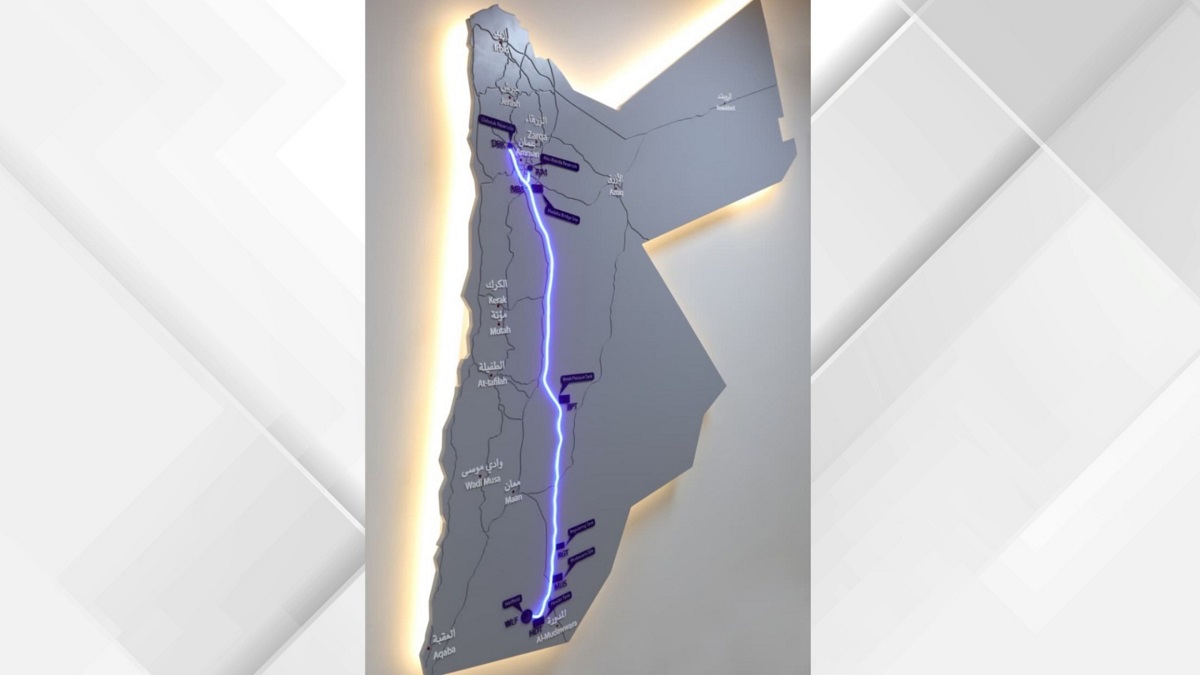
The project’s capital cost is estimated at around $4.3 billion, while
its total cost, including financing, is estimated at approximately
$5.8 billion. It includes seawater desalination and a water carrier
extending approximately 438 to 450
kilometers, as well as a solar power plant with a capacity of around
281 megawatts in Al Quweira.
Farajat said the broader economic value of the project lies in the
activity that could develop around the water sector. He called for
localizing the related value chain in Aqaba by making use of the
port, economic zone, industrial infrastructure and renewable energy
resources.
He said the steel pipe plant could form the basis for an expandable
national industry supplying water, energy and infrastructure
projects. He also called for studying the possibility of establishing
a Jordanian industry for reverse osmosis membranes and their
components, as well as research and development centers, laboratories
and technology partnerships in Aqaba.
Such measures, he said, could support investment opportunities,
create specialized jobs and contribute to the growth of startups.
Farajat said the project could support industry, tourism, investment
and logistics, while contributing to the development of Aqaba as a
center for research and development in desalination, energy,
artificial intelligence and the marine environment. It could also
help reduce pressure on groundwater resources and promote the reuse
of treated water.
He stressed the importance of developing an economic plan alongside
the project, with clear indicators covering local investment,
employment, local content and research and development spending. This
would help ensure that the National Water Carrier contributes to
economic growth in addition to its role in securing water supplies.
Economic expert Hossam Ayesh said the project represents a
significant strategic step that could support Aqaba’s position on the
global economic map by contributing to the development of a new
industrial and investment base in the city.
He said the project aims to desalinate around 300 million cubic
meters annually through a water transmission line extending
approximately 450 kilometers. Renewable energy sources are expected
to cover around 31 percent of the project’s electricity needs,
supporting construction, equipment, engineering services, maintenance
and transport activities during implementation.
Ayesh said the project’s direct impact would be to strengthen water
security, supporting population, tourism, industrial and investment
growth and making water an important part of the infrastructure
supporting economic and investment activity.
He said the JD120 million steel pipe plant represents an example of
localizing industries associated with the project through increased
local procurement, higher added value and job creation. He added that
this approach could support the development of other strategic
projects related to energy, transport and infrastructure.
Ayesh said the National Water Carrier is also linked to clean energy
projects in Aqaba, particularly the green ammonia project, whose
investments are estimated at more than $1 billion and whose
production capacity is around 100,000 tons annually. The project is
supported by a 550-megawatt solar power plant, supporting Aqaba’s
potential to develop as a regional center for green industries, clean
energy and water.
He stressed the need to increase the local content of spending
associated with the project by qualifying Jordanian suppliers,
training workers and transferring technology. This would enable
national companies to participate in supply chains and allow the
local economy to benefit from the project’s capital expenditure.
On August 1, the Aqaba Special Economic Zone Authority, in
cooperation with the Ministry of Water and Irrigation, launched a
single-window platform dedicated to the National Water Carrier
Project. The platform aims to unify and simplify licensing and permit
procedures and accelerate project implementation.
The National Water Carrier represents an opportunity to further
develop Aqaba’s economic role by linking water security with
industry, energy, investment, logistics, research and development.
//Petra// WH