Jordan’s Q2 2026 GDP Expands 3.0%, Outperforming Regional Headwinds, International Forecasts
ENV-KUWAIT-SUSTAINABLITYKuwait strengthens environmental sustainability through strategic initiativesBy Zahra Al-Kadhmi

HLT-KUWAIT-SURGERYKuwait advances health sector with robotic, remote surgeryBy Mohammad Al-Moseb

Saudi Arabia’s Voluntary Carbon Market Fuels the Shift to a Low-Carbon

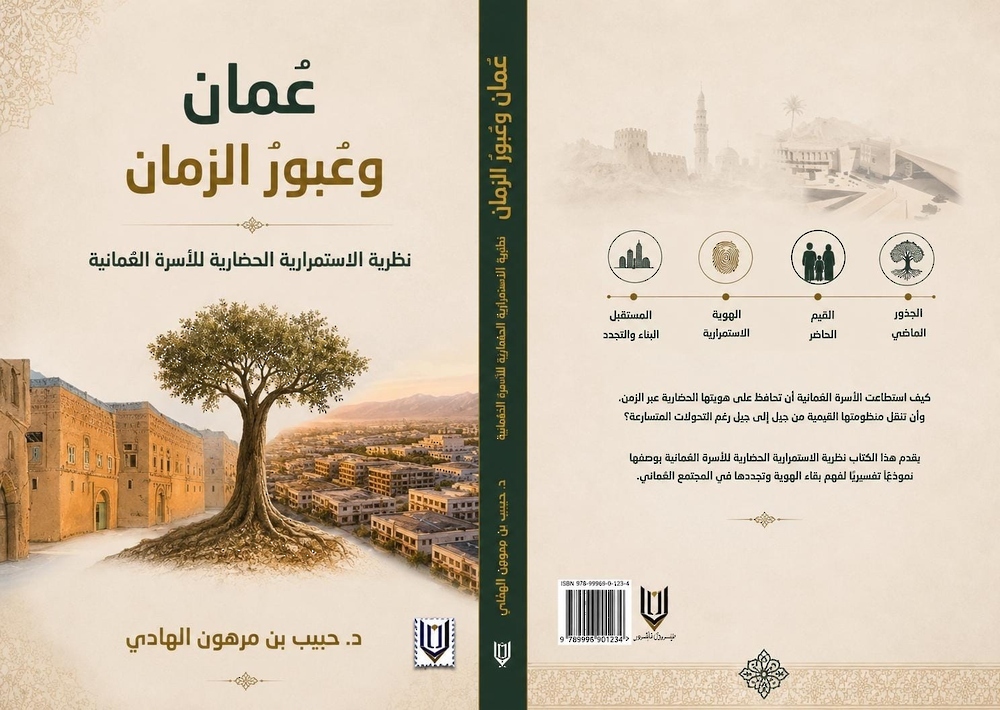
New Omani Book
Proposes Theory of Civilisational Continuity of Omani Family
Muscat, 20 Jul
2026 (ONA) — Dr. Habib bin Marhoon Al Hadi has published a new scholarly work
titled “Oman and the Passage of Time: The Theory of Civilisational
Continuity of the Omani Family,” a 427‑page volume that presents an
intellectual and scholarly framework rooted in the distinctiveness of the Omani
experience. The book explores how the Omani family has sustained its role in preserving
national identity, transmitting values and belonging across generations, and
reinforcing its position as a cornerstone of social development and
civilisational sustainability.
The book poses
a central question: how has the Omani family maintained its civilisational
continuity over centuries, despite the rapid political, economic, social,
cultural and technological transformations that Oman has witnessed? It offers
scientifically grounded answers based on years of research combining historical
study, civilisational analysis, field research and theory‑building.
The theory
defines civilisational continuity as a dynamic process involving the
reproduction of values, identity and collective memory in ways that adapt to
change — not merely the preservation of cultural heritage. The family is seen
as an active institution in preserving national character and balancing
authenticity with renewal.
The work goes
beyond theory, offering an explanatory model, a proposed system of national
indicators, and a vision for a national observatory to monitor family,
childhood and civilisational continuity. This is intended to support national
policies and programmes aligned with Oman Vision 2040 in the areas of national
identity, social development and human development.
The book is
organised into eight chapters, covering the concept and theoretical framework
of civilisational continuity, its historical roots in the Omani experience, the
role of social institutions, the family as the primary incubator of values and
identity, and the impact of social, cultural and digital transformations. The
final chapters present field study findings, the theory itself, and a
forward‑looking vision for civilisational sustainability.
Dr. Al Hadi
said the book is the result of a research journey spanning years, born from a
question about how Omani society has preserved its civilisational continuity
despite profound historical transformations. The findings showed the family to
be the most influential institution in preserving national identity,
transmitting values, safeguarding social memory and reproducing Omani character
generation after generation.
He added that
the book views civilisational continuity as a society’s ability to preserve its
essence while reproducing it in ways that align with changing circumstances,
balancing authenticity with renewal and identity with openness. It offers not
only a scientific theory but also an explanatory model, a system of indicators
and an institutional vision for future studies and national policies on family,
childhood and human development.
Published by
Luban Publishing House, the book adds to Dr. Al Hadi’s body of work in Omani
history, educational thought, civilisational studies and scientific research.
—
Ends/Khalid