Jordan’s Q2 2026 GDP Expands 3.0%, Outperforming Regional Headwinds, International Forecasts
ENV-KUWAIT-SUSTAINABLITYKuwait strengthens environmental sustainability through strategic initiativesBy Zahra Al-Kadhmi

HLT-KUWAIT-SURGERYKuwait advances health sector with robotic, remote surgeryBy Mohammad Al-Moseb

Saudi Arabia’s Voluntary Carbon Market Fuels the Shift to a Low-Carbon

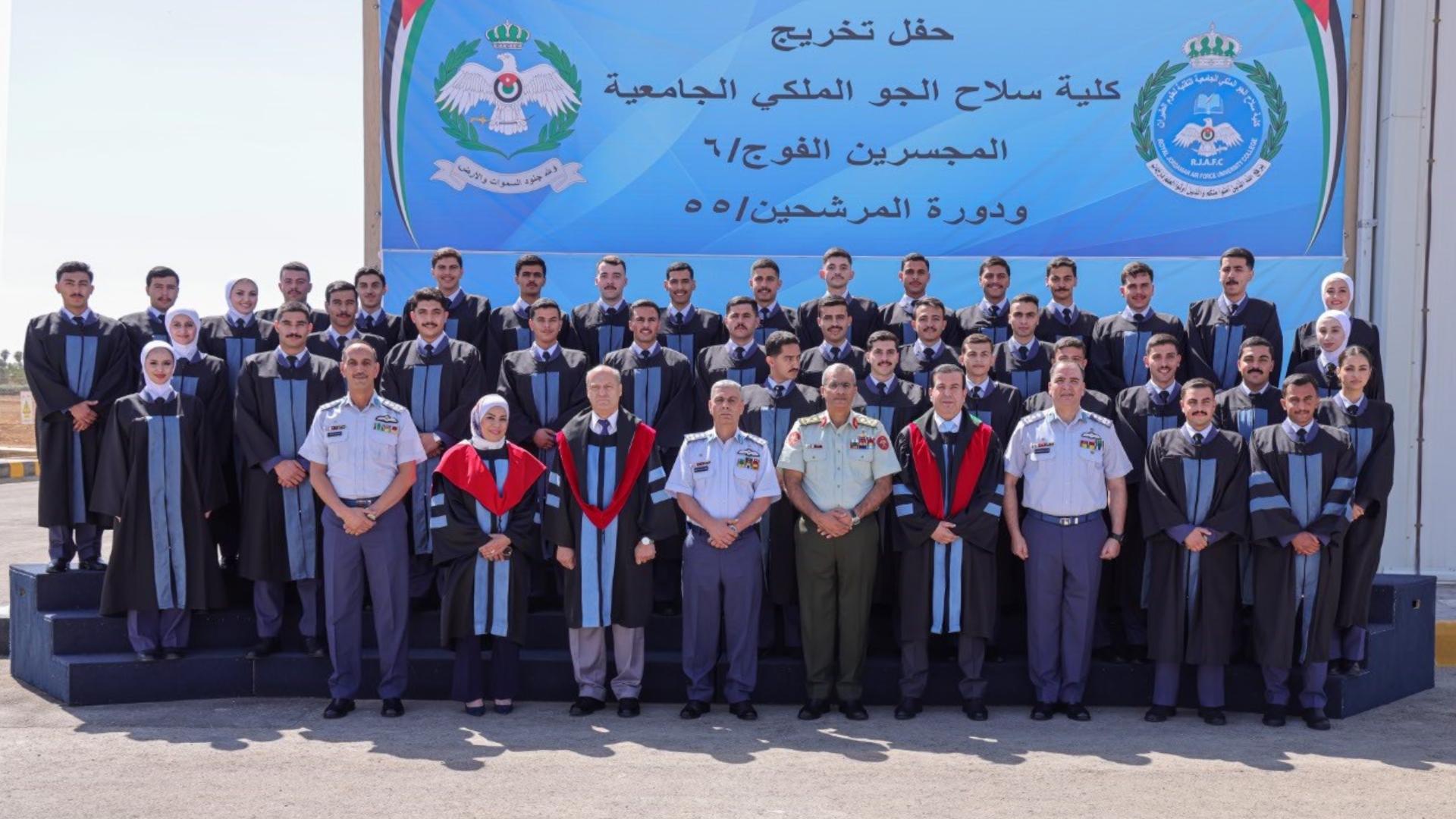
Amman, Oct 7 (Petra) – Chairman of the Joint Chiefs of Staff Major
General Majdi Al Harasis presided at the Royal Air Force College over
a graduation ceremony for the sixth cohort of officers enrolled in
the bridging program, Aviation Sciences and Air Surveillance and
Navigation Sciences, and the 55th Officer Candidate Course, Aviation
Management and Unmanned Aerial Vehicle (UAV) Operations.
The ceremony was attended by the Royal Air Force commander, Chairman
of the College’s Board of Trustees and Dean.
In his address the dean of the college said the institution has
undergone “a qualitative shift” in its academic journey, now
comprising six departments offering bachelor’s degrees, in addition
to a Department of Graduate Studies and Scientific Research that
offers a master’s degree.
The expansion reflects the College’s educational mission and
commitment to meeting the requirements of the Armed Forces and the
needs of the labor market, he said.
He said the College has begun admitting civilian students of various
nationalities into the Commercial Aviation Sciences program, driven
by an interest by civil aviation academies in Jordan in enrolling
their students in the College’s academic programs.
Furthermore, the College has welcomed employees from both the public
and private sectors, as well as university professors, to enroll in
the Master’s program in Human Resources and Defense Management.
The college has met the requirements of the Association of Arab
Universities, becoming the first Arab university college to secure
active membership, an achievement that enhanced its academic standing
and granted it accreditation and recognition among higher education
institutions across the Arab world, said the dean.
Towards the end of the ceremony, attended by senior Armed Forces
officers, the army chief presented diplomas and awards to graduates.
The academic and specialized expansion is in line with the Jordan
Armed Forces’ commitment to investing in human capital and elevating
qualification and training standards in priority areas.
It helps to prepare a qualified national workforce capable of
addressing developments in the defense and aviation sectors, while
enhancing the Armed Forces’ readiness to carry out their duties and
responsibilities with efficiency and competence.
//Petra//SS